
What Happened to Abercrombie & Fitch? Inside the Reinvention of an American Fashion Brand
Abercrombie & Fitch spent the 1990s and 2000s defining exactly who it wanted its customers to be. When that vision became a liability, the company did something far more difficult than changing its advertising. It dismantled much of what had made Abercrombie famous and rebuilt the brand around the lives its customers were actually leading.
There was a time when entering Abercrombie & Fitch felt less like walking into a clothes shop than crossing into somebody else's idea of how youth was supposed to look. The stores were deliberately dark, music played loudly, Fierce cologne hung heavily in the air and enormous photographs of athletic young bodies competed with the merchandise for attention. Store employees were themselves incorporated into the presentation of the brand, while shirtless male greeters became a familiar feature at important openings and locations. Abercrombie had developed a retail environment so controlled that sight, sound, smell, architecture, staffing and advertising all appeared to be communicating the same thing.
That thing was not really a polo shirt, a hoodie or a pair of jeans. Under Mike Jeffries, who led the company from 1992 until 2014, Abercrombie sold a particular fantasy of American youth: attractive, athletic, affluent-looking, socially confident and, in much of its most recognisable imagery, strikingly narrow in the kinds of bodies and faces chosen to represent it. Photographer Bruce Weber helped establish a visual language of black-and-white bodies, sport, camaraderie and sexuality that became inseparable from the brand. The clothes provided a way into this world, but the world was often the more important product.
Two decades later, Abercrombie is once again placing famous, beautiful people at the centre of major advertising. Its Fall 2026 denim campaign features Emily Ratajkowski, Paloma Elsesser and New York Giants players Jaxson Dart and Malik Nabers, photographed by Cass Bird around Manhattan. There is denim, American sport, New York and the familiar promise that ordinary clothes can become more desirable when surrounded by the right people and cultural signals. Yet the resemblance is deceptive. The current campaign celebrates different bodies and individual styles, while the product itself is considerably more visible. Ratajkowski describes the attraction of clothes that fit into her own life rather than transform her into somebody else.
This is why the Abercrombie story is more interesting than a conventional corporate comeback. The company has arrived back at some of the same tools that once made it powerful, but only after spending more than a decade changing the philosophy underneath them. It did not simply make an exclusionary brand more inclusive. It changed the direction in which the relationship between company and customer worked. Old Abercrombie prescribed an identity and asked shoppers to fit themselves into it. The business that emerged from its decline started listening, observing and designing around lives customers were already living.
What happened to Abercrombie & Fitch?
Abercrombie & Fitch lost much of its cultural and commercial momentum during the late 2000s and 2010s as the market around it changed and some of the distinctive characteristics that had once driven its desirability became liabilities. Prominent logos fell out of fashion, ecommerce and fast-fashion competitors altered how young consumers discovered and bought clothes, mall traffic weakened and the company's narrow positioning attracted growing criticism. By 2017, Abercrombie & Fitch Co. was reporting its lowest annual revenue since 2010.
The transformation began before any single formal “rebrand”. Jeffries left in December 2014, and in 2015 the company announced that it would stop using shirtless male models at store openings, move away from sexualised marketing and abandon practices that considered body type or physical attractiveness in store recruitment. The old Look Policy was replaced, employees stopped being referred to as models and a retail experience that had deliberately prioritised theatre began evolving towards something more open and conventional.
Under Fran Horowitz, who joined the company in 2014 and became chief executive in 2017, the reinvention moved deeper into the organisation. Abercrombie differentiated itself more clearly from teen-focused Hollister, targeted customers in their twenties and beyond, developed products around specific needs and occasions, modernised its stores and digital operation and systematically reduced its dependence on enormous international flagships. Horowitz has described the internal cultural shift as one from “fitting in” to “belonging”, while the company's turnaround playbook prioritised getting the product right before aligning the brand's voice and customer experience around it.
The financial recovery has been substantial. Abercrombie & Fitch Co., which includes both the Abercrombie and Hollister brand families, recorded $4.95 billion in sales in fiscal 2024 and $5.27 billion in fiscal 2025. The story is not one of uninterrupted growth: Abercrombie-brand sales declined 1 per cent in fiscal 2025 while Hollister grew 15 per cent, before Abercrombie returned to 3 per cent growth in the first quarter of fiscal 2026. That qualification matters because a successful turnaround does not permanently protect a fashion brand from changing tastes.
What makes the recovery remarkable is therefore not simply that sales returned. It is how much of the original Abercrombie had to be taken apart before they did.
The brand that knew exactly who it wanted
Mike Jeffries' Abercrombie was, from a branding perspective, extraordinarily disciplined. By the mid-2000s, the company had created an environment in which almost every consumer-facing element reinforced a shared set of associations. Bruce Weber's photography supplied the bodies and mythology; stores supplied physical theatre; Fierce provided an olfactory signature; the product supplied visible logos; employees extended the aesthetic into human form. Even if a person disliked Abercrombie, they were unlikely to misunderstand it.
That clarity helped ordinary apparel behave like a status product. Abercrombie did not invent denim, hoodies or polo shirts, nor did it need to. Its achievement was to make particular versions of those things function as evidence of participation in a desirable social group. The moose logo could communicate something before anyone considered the quality of the fabric or construction, while the store environment made purchasing the garment feel like acquiring a small piece of the lifestyle represented on the walls.
Jeffries was unusually candid about this strategy. In a 2006 interview with Salon, he talked about targeting the “cool kids” and acknowledged that the brand was exclusionary. The comments attracted substantially greater attention when they resurfaced years later, but they were consistent with the company Abercrombie had spent years building. Exclusivity was not an accidental side effect of the positioning. It helped create its social value.
This is an uncomfortable but necessary part of understanding why old Abercrombie worked. Brands built around belonging frequently derive some of their power from establishing a boundary around the group. The harder the group appears to enter, the more valuable membership can feel to those seeking admission. Abercrombie turned that mechanism into an unusually visible retail strategy.
The problem was what happened when the boundary itself became the story.
When aspiration depended on exclusion
The consequences of Abercrombie's tightly controlled image were not limited to advertising. In 2004, the US Equal Employment Opportunity Commission announced a $50 million settlement resolving its lawsuit alongside two private class actions. The EEOC case alleged discrimination in recruitment, hiring, job assignment and promotion on the basis of race, colour, national origin and sex. The consent decree required changes including nondiscriminatory hiring procedures and greater efforts to recruit and promote minorities and women.
The underlying issue was unusually connected to branding. When store employees are treated as part of the visual experience, a company's ideas about who looks right for the brand can begin influencing decisions that are legally employment decisions rather than casting choices. Abercrombie's historical practice of referring to sales associates as “models” illustrated just how closely those two things had become connected.
A separate dispute involving Samantha Elauf, a Muslim job applicant who wore a hijab, ultimately reached the US Supreme Court. Abercrombie had declined to hire Elauf in circumstances connected with its Look Policy; in 2015, the Supreme Court held that an employer could not make a religious practice a motivating factor in an employment decision while avoiding its accommodation duties simply because the applicant had not explicitly requested an exception. The case turned the company's aesthetic rules into a national conversation about the limits of employer-controlled appearance.
The reputational problem intensified when Jeffries' old remarks resurfaced in 2013. Seven years after the original Salon interview, social media provided consumers with a completely different mechanism for circulating and responding to them. What had once existed as the unusually blunt articulation of a provocative positioning strategy became evidence, for critics, of a company whose conception of its ideal customer was fundamentally at odds with changing cultural expectations.
None of this means that controversy alone caused Abercrombie's commercial decline. The problem was that the criticism arrived at the same time that the fashion and retail conditions supporting the old business were also beginning to weaken.
The culture changed before Abercrombie did
Abercrombie had thrived in a market where a relatively small number of retailers could exercise enormous influence over teenage fashion. Shopping centres concentrated brands in one place, magazines and celebrities helped establish the dominant visual codes, and a logo worn across the chest could work as a useful social shorthand. By the early 2010s, each of those conditions was changing.
Large logos became less desirable. Jeffries himself told investors in 2014 that the company intended to take its North American logo business towards practically nothing as Abercrombie attempted to increase its fashion relevance. The move was significant because the logo had once performed so much of the product's social work. Removing it meant the clothes increasingly had to compete on silhouette, styling, fit and desirability rather than simply identification.
At the same time, online retail and fast fashion radically increased the number of places consumers could find newness. Social media fragmented the authority previously held by large fashion brands, magazines and mall retailers. Rather than receiving a relatively coherent instruction about what was fashionable, customers could construct personal identities from creators, niche brands, vintage clothing, resale platforms and constantly changing online aesthetics. Vogue Business reported Horowitz's view that, by the time the company was trying to recover, consumers increasingly wanted to develop their own identities rather than have a brand prescribe one for them.
This affected Abercrombie more severely than a retailer whose proposition had always been product-first. If the company's advantage had been its ability to define the person its customer should want to become, a cultural movement towards individuality struck at the function of the brand itself.
It also created an awkward question of age. The teenagers who had embraced Abercrombie at its peak did not remain teenagers. They entered their twenties and thirties, while younger consumers grew up with different cultural reference points and different expectations of fashion. Abercrombie could continue attempting to manufacture the same fantasy for a replacement generation, or it could reconsider whether the job of the brand needed to change.
Why did Abercrombie lose popularity?
Abercrombie & Fitch lost popularity because several problems converged rather than because consumers suddenly rejected the company for one reason. Its highly recognisable preppy and logo-heavy aesthetic became less fashionable, online and fast-fashion competitors provided faster and more varied alternatives, shopping-centre culture weakened and social media reduced the ability of a dominant retailer to dictate a single aspirational image. At the same time, criticism of Abercrombie's historical employment practices and exclusionary positioning damaged the cultural appeal of an identity that had once made the company distinctive.
The decline exposed the difference between brand recognition and brand relevance. Abercrombie did not have an awareness problem. People knew the name, remembered the smell and could describe the stores. The difficulty was that some of those memories were increasingly attached to an era consumers felt they had moved beyond.
When Jeffries left in 2014, the company therefore faced a harder task than making itself more famous. It had to change what fame meant.
Abercrombie begins dismantling Abercrombie
The first phase of the transformation was defined largely by subtraction. In April 2015, Abercrombie announced that it would stop considering body type or physical attractiveness in hiring store staff, discontinue shirtless models at store openings and events, move away from sexualised marketing and replace the Look Policy with a less prescriptive dress code. Employees who had once been called “models” became brand representatives.
These changes removed some of the company's most famous distinctive assets. From the perspective of conventional brand-management theory, that could look reckless. The dark stores, loud soundtrack, highly controlled staff appearance and sexualised imagery were memorable precisely because competitors did not behave in the same way.
But distinctiveness and desirability are not interchangeable. A brand asset can be exceptionally memorable while simultaneously acquiring associations that make it commercially damaging. Abercrombie had reached a point where preserving everything consumers recognised would have meant preserving many of the reasons the brand was becoming harder to choose.
The resulting brand initially became quieter. The challenge was that removing the old meaning did not automatically create a compelling new one. Abercrombie now needed to work out what it was actually for.
From fitting in to belonging
The language Fran Horowitz has used to describe the company's cultural change provides perhaps the clearest summary of what followed. Abercrombie & Fitch Co. says she rallied teams around the idea of “belonging versus fitting in”, combined with a customer-centred operating philosophy. The distinction sounds slight until it is placed alongside the history of the brand.
Old Abercrombie had been extraordinarily effective at making customers want to fit in. There was an identifiable look, an identifiable body, an identifiable store environment and a recognisable uniform. Belonging was conditional upon moving closer to that ideal.
The newer philosophy reverses the relationship. A customer can belong without becoming indistinguishable from everybody else already inside. That idea influences far more than advertising casting. It affects sizing, fit, product assortment, employee culture and the number of different situations in which the clothes need to work.
Horowitz has also described the practical turnaround playbook in a revealing order: product first, then the appropriate voice and experience. That sequence matters. The company was not starting with a new campaign and asking the rest of the organisation to live up to it. It was trying to create products people genuinely wanted and allowing the communications and retail environment to follow.
The rebrand, in other words, began to behave less like a marketing exercise and more like an operating system.
Abercrombie and Hollister had become too similar
One of the less glamorous problems was also one of the most important. Abercrombie had become insufficiently differentiated from Hollister, its younger sibling brand. Horowitz later characterised the struggling Abercrombie as having become heavily associated with jeans and T-shirts for teenagers, leaving too much overlap with a Hollister business already built around that customer.
The solution was an exercise in brand architecture. Hollister could retain a stronger focus on teenagers while Abercrombie deliberately moved into the twenties and beyond. This gave each brand a clearer job and reduced the need for them to compete for the same customer inside the same company.
For Abercrombie, that opened a piece of demographic territory management believed was underserved. Horowitz has repeatedly described the mid-to-late twenties customer as a “white space” and a sweet spot. These were people building careers and relationships but still spending heavily around friends, travel, social occasions, exercise, dinners and weddings.
The decision changed the logic of the company. Instead of asking how to make Abercrombie attractive to another generation of 17-year-olds, it could ask what a person approaching 30 actually needed from their wardrobe.
That question produced one of the most distinctive ideas in the turnaround.
The 96-hour weekend
Abercrombie's modern brand strategy became organised around what the company calls the long weekend. Rather than defining the customer primarily through attitude or appearance, teams mapped a 96-hour period of their life and considered what they might actually do during it: finish work, exercise, meet friends for drinks or dinner, travel, attend a bachelorette party, go to a wedding or spend a weekend away.
This sounds like a merchandising exercise, but it represents a fundamental change in the relationship between brand and consumer. The old Abercrombie created a world and invited customers to enter it. The newer company began with the customer's existing world and looked for places Abercrombie could enter.
Suddenly, categories that might otherwise have appeared like opportunistic extensions become coherent. Activewear belongs in the workout. Tailoring belongs at work or dinner. Dresses belong at weddings. Casualwear belongs on the flight. Denim can travel across most of them. A Wedding Shop and YPB activewear are no longer random attempts to increase assortment breadth; they are attempts to capture more of the customer's actual calendar. Abercrombie itself says both YPB and Curve Love emerged from direct customer requests.
The strategy also allowed the brand to grow without demanding that every garment look visibly Abercrombie. Under the old system, consistency came partly from logo, styling and uniformity. Under the new one, consistency could come from the same customer wearing very different products across different parts of a weekend.
That is a much more flexible form of brand loyalty.
What happens when a fashion brand actually watches its customers?
Abercrombie's commitment to customer research has become unusually literal. In 2025, The Sunday Times reported that merchandisers and designers had joined customers on a weekend in Nashville, spending time with them, asking questions and observing the way they lived. Horowitz said similar exercises take place periodically, with employees accompanying customers for activities such as drinks or sporting events in order to understand what they are looking for.
The contrast with the Jeffries era is almost too neat. Old Abercrombie told the customer what desirability looked like. New Abercrombie sometimes goes away for the weekend with them and takes notes.
This does not mean the company has surrendered creative judgment to focus groups. Fashion brands still need to anticipate desire rather than merely fulfil a questionnaire. But the research changes where the company begins. Instead of starting from a tightly controlled fantasy and searching for consumers willing to enter it, Abercrombie begins with behaviours, frustrations and occasions, then decides what product and brand expression might answer them.
The organisation has also become more responsive operationally. Horowitz told The Sunday Times that supply-chain changes had reduced lead times for some basics to as little as two weeks, while the company tests smaller quantities and replenishes products when demand proves itself. New styles arrive frequently rather than relying solely on the traditional seasonal reset.
That matters because customer-centred branding loses credibility if the organisation cannot react quickly enough to what it learns. Abercrombie's comeback required the machinery behind the brand to become as responsive as the marketing claimed the company was.
Curve Love: the product that proved the idea could work
Few products illustrate the difference between old and new Abercrombie as neatly as Curve Love denim. Introduced in 2019, the fit was designed around a different waist-to-hip ratio, giving customers additional room through the hip and thigh while retaining a closer fit at the waist. Horowitz has described it as a turning point because it addressed customers who could not, or previously would not, shop the brand. By 2024, she said Curve Love represented almost half of Abercrombie's women's denim business.
The symbolism is unusually strong. Historic Abercrombie had built cultural power around a narrow visual ideal. One of the products central to the modern recovery became successful precisely because the company acknowledged that one standard shape could not serve every customer.
Yet Curve Love is valuable to the story because it is not merely symbolic. Customers bought it. The change to representation translated into a commercially meaningful product proposition rather than existing only in campaign imagery.
This distinction is essential in any discussion of Abercrombie's inclusivity. A company can place a wider variety of bodies in an advertisement without materially changing who can wear the clothes. Expanded fits, lengths and sizing change the actual consumer experience. They move inclusion from communications into product design.
The new Abercrombie has repeatedly built from that principle. YPB activewear, occasion clothing and wedding products all respond to identified customer needs, helping the company expand from selling a recognisable youth uniform into selling a wardrobe.
From jeans to weddings
Abercrombie's move into weddings is particularly revealing because it would have seemed almost absurd during the brand's peak teenage years. The contemporary Wedding Shop encompasses bridal-event clothing, dresses, tailoring and occasionwear intended to serve the social calendar of customers in their twenties and thirties.
This does not represent Abercrombie becoming a traditional formalwear company. It represents the long-weekend strategy being taken seriously. If a customer's life now includes rehearsal dinners, destination weddings, work drinks, workout classes and weekends away, then a brand seeking a larger share of their wardrobe needs to appear across those moments.
The approach is almost the inverse of the old uniform. Historic Abercrombie's power came partly from making different customers look recognisably similar. Contemporary Abercrombie can sell radically different garments to the same person precisely because it no longer depends on every product functioning as a badge of membership.
The company has therefore traded one form of consistency for another. The visual uniform is weaker, but the relationship with the customer's lifestyle is broader.
That has consequences for marketing too.
From telling customers what to wear to watching how they wear it
Old Abercrombie advertising was profoundly top-down. A small group of executives and creatives determined the world of the brand, photographed it and projected it towards customers. Modern social media makes that level of control both difficult and, in many circumstances, undesirable.
Abercrombie now makes extensive use of influencers, affiliates and platform-native creators. Chief marketing officer Carey Collins Krug has said content produced by creators native to platforms such as TikTok, Instagram and YouTube can outperform content the company makes specifically for those channels. The company has also connected its renewed success to influencer and affiliate programmes as part of a broader system in which product, voice and experience are designed to work together.
Again, there is a meaningful reversal. Bruce Weber once helped Abercrombie construct a highly controlled representation of how the ideal customer should appear. Social creators now show audiences how clothes fit into many different bodies, wardrobes and lives. The company has not stopped shaping its image, but it no longer needs to own every depiction of the brand.
This is particularly valuable for a company whose historic weakness was excessive prescription. Seeing hundreds of people style the same trousers differently does something the old marketing never intended to do: it allows the customer to imagine Abercrombie without first imagining themselves as an Abercrombie archetype.
The brand has become less uniform and, paradoxically, more wearable.
Why did Abercrombie close its flagship stores?
Abercrombie's enormous international flagships were once among the most spectacular manifestations of its brand, but many eventually became expensive legacy assets in a retail market moving towards digital and omnichannel shopping. In fiscal 2020 the company accelerated its exit from several European locations, closing Düsseldorf and announcing early closures for London, Munich and Paris, alongside lease-expiry closures in Brussels, Madrid and Fukuoka. Those actions reduced its flagship count from 15 at the beginning of the year to eight and removed approximately $85 million of lease liabilities from the balance sheet.
It would be misleading to interpret every closure simply as evidence of failure. By this stage, the company was deliberately changing what it expected a physical store to do. A huge flagship designed to generate spectacle and tourist traffic made sense when physical retail itself was the dominant communications medium. It became harder to justify when discovery, marketing and increasing volumes of commerce were happening through a phone.
The symbolism is significant. The old flagship was designed to make Abercrombie difficult to ignore. Its scale, darkness, scent and queue created distance between the outside world and the one waiting inside. The newer retail strategy is built around reducing that distance.
Abercrombie did not stop believing in stores. It stopped believing that a successful store had to behave like a monument.
The store returns with the opposite job
The company's 2022 Getaway store concept makes the philosophical change particularly visible. Inspired by a hotel lobby, the format was designed around omnichannel shopping, product discovery and easier movement through the store. It incorporated dedicated product areas such as a denim studio, improved fitting rooms and functions supporting customers who might browse, collect an online order or use the store as one part of a larger digital shopping journey.
Compare that with old Abercrombie and the change is more meaningful than brighter lighting. The previous store protected the fantasy from the ordinary mall outside. The newer store makes products easier to see, fit and acquire. One was constructed around controlled mystery; the other around reduced friction.
The company had already begun moving in this direction before Getaway. A 2017 store prototype introduced a transparent storefront, more open sightlines and historical branding dating back to the early twentieth century. The redesign effectively replaced concealment with visibility.
That transition also created an opportunity to answer another problem: if Abercrombie was no longer defined by its most famous 2000s imagery, what history could it draw upon instead?
The answer was waiting more than a century earlier.
Abercrombie existed before the mall
Abercrombie & Fitch traces its origins to 1892, when David Abercrombie founded an outdoor-goods business in New York selling premium equipment for camping, fishing and hunting. The company later developed an association with sporting pursuits, exploration and affluent American leisure before changing ownership and, eventually, being transformed into the youth fashion retailer recognised by a generation of mall shoppers.
For the modern company, this history provides something strategically useful: a version of Abercrombie that predates Mike Jeffries. Rather than treating 1999 as the beginning of its cultural identity, the brand can draw on New York, sport, outdoors, travel, American leisure and classic clothing from an archive extending back to the nineteenth century.
The company began actively reconnecting with that material during the earlier stages of its transformation. Its 2017 “This Is the Time” campaign explicitly drew on a 125-year history of adventure and exploration, while archival projects have revisited historic garments and even clothing associated with John F. Kennedy.
The long-weekend positioning can itself be understood as a modern translation of this older idea of escape. The Wall Street Journal reported that Abercrombie's marketing leadership looked back to the company's heritage around “the great escape” and reframed it for the twenty-something customer as the long weekend.
This is a sophisticated use of heritage. Abercrombie is not pretending to be an outdoor outfitter again. It is using the emotional territory underlying its oldest history, escape, leisure and American life, to support a completely contemporary proposition.
When a recent chapter of brand history becomes difficult, an older one can sometimes provide somewhere else to stand.
The numbers prove this was more than better PR
By 2023, the commercial recovery was becoming difficult to explain away as nostalgia or clever marketing. Abercrombie & Fitch Co. reported $4.28 billion in annual revenue, up 16 per cent from the previous year, and followed it with nearly $4.95 billion in fiscal 2024. Operating margin reached 15 per cent in 2024, while the company's operating income and earnings per share increased sharply.
Fiscal 2025 produced another company sales record at $5.27 billion, although the composition of that growth deserves attention. Hollister-brand revenue rose 15 per cent to approximately $2.74 billion, while Abercrombie fell 1 per cent to approximately $2.52 billion and comparable sales declined 7 per cent. By the first quarter of fiscal 2026, Abercrombie-brand sales had returned to 3 per cent growth.
The distinction matters because the phrase “Abercrombie comeback” can blur the difference between the namesake brand and the publicly listed company containing multiple brands. It also helps prevent the turnaround story becoming self-congratulatory. Abercrombie has recovered dramatically, but fashion offers very little time for victory laps.
The present challenge is increasingly about sustainability. A strategy designed around young millennials cannot simply age indefinitely with the same people, and Horowitz has acknowledged the danger of allowing the product to age up until the brand becomes obsolete. Gen Z is moving into Abercrombie's target territory while the consumers who first rediscovered the brand during its reinvention are moving beyond it.
The machine that Abercrombie built to listen will now have to keep listening.
Was this really a rebrand?
Calling the Abercrombie story a rebrand is useful shorthand, but it understates what actually happened. A conventional rebrand changes the visible expression of an organisation. Abercrombie changed who it was targeting, how its two largest brands were differentiated, how employees were recruited and presented, which products it developed, which body shapes those products accommodated, how stores were designed, how merchandise moved through the supply chain and how customer behaviour influenced decision-making.
The identity followed those changes rather than leading them.
This is one reason the Abercrombie case is more useful than many famous redesign stories. A new logo cannot compensate for a product customers do not want. Diverse casting cannot make an inflexible size range inclusive. A manifesto about listening to customers means little when the supply chain takes too long to respond to what they say.
Abercrombie changed those underlying systems first. Its own description of the playbook, product, then voice, then experience, is unusually revealing.
Only after years of doing that work could the company safely become glamorous again.
Abercrombie dares to become aspirational again
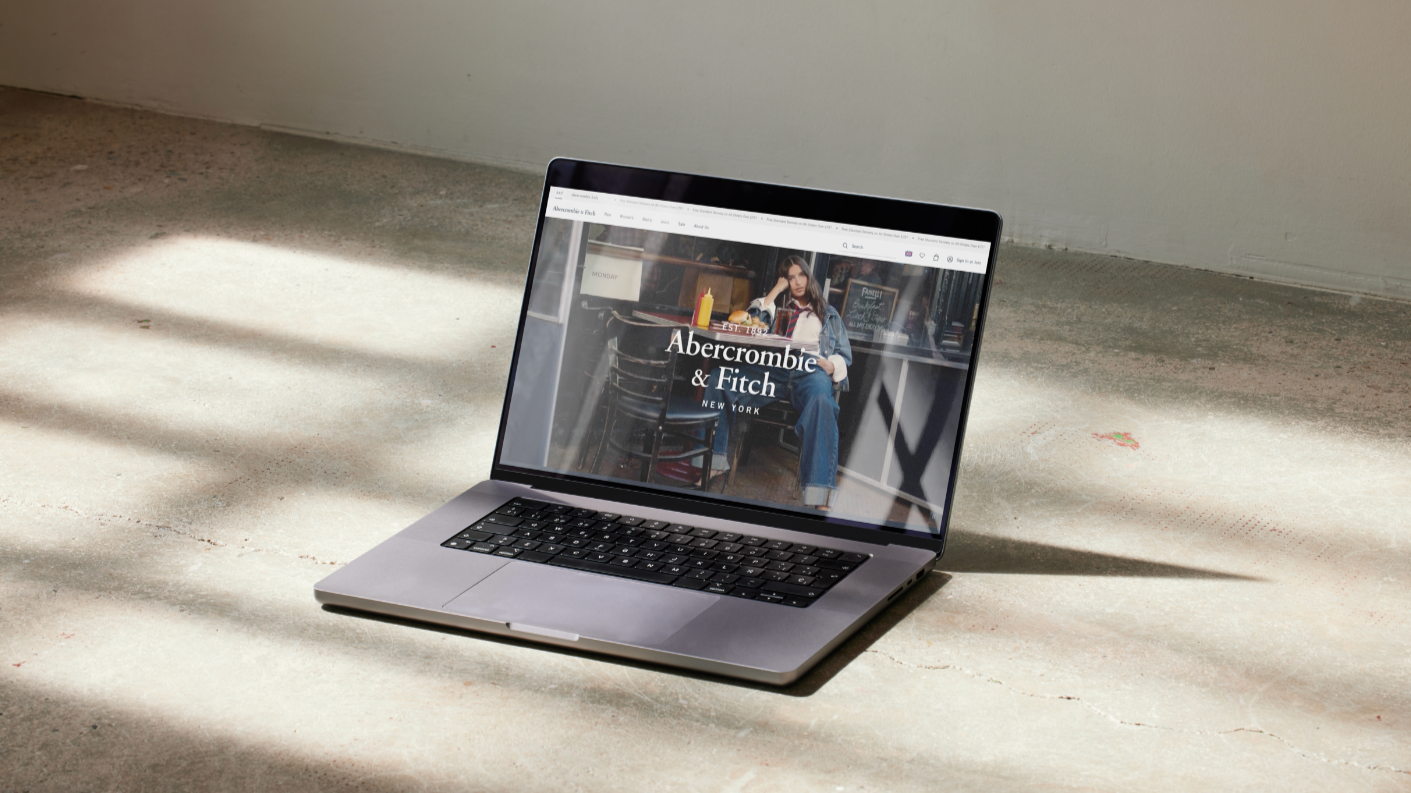
The Fall 2026 Denim Made Iconic campaign feels significant because it suggests a brand confident enough to reclaim some of the machinery of old Abercrombie without reclaiming its worldview. Emily Ratajkowski, Paloma Elsesser, Jaxson Dart and Malik Nabers are culturally recognisable faces photographed by Cass Bird around downtown Manhattan, placing fashion, sport, celebrity and New York together in one polished image of contemporary American life.
These are not completely new ingredients. Old Abercrombie understood the value of athletic bodies, beautiful photography and idealised American identity exceptionally well. What has changed is how uniform the people inside that world are expected to be.
Elsesser complicates the body ideal historically associated with the company. Ratajkowski arrives with a recognisable identity and personal style of her own rather than functioning anonymously as an example of the Abercrombie girl. Dart and Nabers bring actual professional sport into a brand whose historic athleticism often existed primarily as aesthetic mythology.
The clothes are also doing more of the work. Ratajkowski speaks about wanting jeans that disappear into her life, clothes that feel like herself rather than requiring constant thought. It is an almost perfect articulation of how far the proposition has moved from the idea that clothes could transform the wearer into somebody more socially desirable.
Abercrombie has not abandoned aspiration. It has changed the object of aspiration.
The almost full-circle moment
This is where the Abercrombie story becomes unusually satisfying as a piece of brand history. The company became famous through American lifestyle imagery, denim and casual staples, fashion photography, sport, attractive cultural figures and theatrical retail. It then spent years reducing, removing or questioning many of the devices attached to that system.
Now several have returned.
Abercrombie is again putting significant talent into campaigns. It is foregrounding denim. It is making New York and American heritage useful. It is partnering with sport, including a wider relationship with the NFL. It has expanded physical retail after years spent optimising its estate. It is once again comfortable creating a fashionable world around relatively accessible clothes.
The difference is that the world no longer requires everyone inside it to resemble the same archetype. Aspiration survives, but uniformity is weaker. American identity survives, but it accommodates more versions of America. The famous face survives, but celebrity no longer functions simply as evidence of one correct form of beauty.
This is why the transformation is almost, but not quite, a 360-degree turn. A complete circle would put Abercrombie back where it started. Instead, the company has recovered some of its old tools after changing the rules governing their use.
That may be a more mature form of rebranding than destroying the past altogether.
Can Abercrombie escape its own memory?
The difficulty is that companies do not own the memories people have of them. While Abercrombie was rebuilding itself, popular culture was still processing the company it had been. Netflix released White Hot: The Rise & Fall of Abercrombie & Fitch in 2022, revisiting the brand's exclusionary reputation, employment controversies and enormous influence on millennial fashion culture. The documentary arrived years after the reinvention had begun, creating an unusual situation in which the old Abercrombie was undergoing a public autopsy while the new Abercrombie was gathering momentum.
The historical legacy has been further complicated by federal criminal charges filed in 2024 against former CEO Mike Jeffries and two other men. Jeffries pleaded not guilty to sex-trafficking and prostitution charges. The allegations concern conduct prosecutors say occurred during and after his tenure, but the criminal case is separate from Abercrombie's current leadership and should not be retrospectively presented as the explanation for the brand's earlier commercial decline.
For the company, there is no credible route to making this history disappear. Nor would pretending it belonged to some unrelated organisation be persuasive. Jeffries ran Abercrombie for more than two decades and helped construct the brand whose extraordinary strength created both its cultural influence and much of the context for the later reinvention.
The relevant question is therefore not whether a company can erase a damaged history. It is whether enough subsequent behaviour can make the present meaningfully different from the past.
Abercrombie's answer has so far been largely practical. Different product. Different hiring principles. Different stores. Different casting. Different sizing. Different customer research. Different leadership. Those changes cannot rewrite history, but they can prevent history from being the only useful explanation of what the brand means now.
What Abercrombie teaches us about rebuilding a damaged brand
The most obvious conclusion from Abercrombie would be that inclusion is good for business. That is true at a level so broad that it tells marketers very little about why this particular turnaround succeeded.
The more useful lesson is that brand strength can become a constraint. Abercrombie's old identity was not weak, confused or inconsistent. It was exceptionally strong, exceptionally clear and deeply embedded across the organisation. The difficulty was that the meaning it had accumulated became less valuable as the culture changed.
That required an unusual response. The company could not preserve every distinctive asset simply because consumers remembered it. It had to distinguish between the parts of Abercrombie that created useful recognition and the parts that trapped the business inside an obsolete idea.
Some things survived. Denim survived. Fierce survived. American heritage survived. New York survived. Fashion photography survived. Attractive people survived. Sport survived. Physical retail survived.
Other things did not. The Look Policy went. Shirtless greeters went. The assumption that staff should conform to one aesthetic went. The dominant logo was dramatically reduced. The giant flagship model was cut back. The idea that exclusion itself made the product more desirable was gradually dismantled.
The company also changed the source of its authority. Jeffries-era Abercrombie became powerful by telling customers what cool looked like. Horowitz-era Abercrombie has repeatedly presented closeness to the customer as its competitive advantage, whether through social creators, product feedback, lifestyle research or literally accompanying customers on weekends away.
That may be the most profound change in the entire story. Abercrombie once built desire by being certain it knew better than the people standing outside its doors. Its recovery began when it became curious about them.
Is the Abercrombie comeback complete?
Commercially, Abercrombie & Fitch Co. has already achieved results that would have seemed unlikely during the weakest years of the previous decade. Record company sales, renewed store expansion, strong product franchises and a return to high-profile cultural campaigns provide clear evidence that this is more than a cosmetic rehabilitation.
Yet the next stage may be harder in a different way. Old Abercrombie was so distinctive that it became restrictive. New Abercrombie has successfully made itself relevant to a much broader group of people, but broader relevance can eventually produce another risk: becoming a very competent supplier of attractive clothes without an equally distinctive cultural point of view.
The Ratajkowski campaign suggests the company understands this. Having spent years making Abercrombie easier to buy, easier to wear and easier to belong to, it is starting to make it more culturally ambitious again. The interesting question is whether it can continue to increase distinctiveness without rebuilding the walls that once made the old brand distinctive in the first place.
That is the real full-circle moment. Abercrombie no longer needs to choose between being aspirational and being accessible. It is attempting to prove that aspiration itself can change.
The old brand constructed a world and decided who was worthy of entering it. The new one has spent years studying the people it wants inside and constructing the clothes around them.
It has returned to denim, celebrity, sport, New York and beautiful photography, but not to the same definition of beauty.
The tools are familiar. The instructions are not.
Abercrombie & Fitch FAQs
What happened to Abercrombie & Fitch?
Abercrombie & Fitch lost cultural and commercial momentum during the late 2000s and 2010s as logo-heavy fashion declined, online and fast-fashion competitors grew, mall shopping weakened and criticism increased around the exclusionary culture associated with the Mike Jeffries era. After Jeffries left in 2014, the company progressively changed its employment practices, marketing, products, stores and target customer, eventually producing a major commercial recovery under CEO Fran Horowitz.
Why did Abercrombie lose popularity?
Abercrombie's decline had several causes rather than one. Fashion moved away from prominent logos and the narrowly defined collegiate style associated with the company, while ecommerce, fast fashion and social media changed how younger consumers discovered clothes. At the same time, employment controversies and criticism of its deliberately exclusionary positioning weakened some of the cultural appeal that had once made Abercrombie aspirational.
When did Abercrombie & Fitch rebrand?
There was no single rebrand launch. Important changes accelerated after Mike Jeffries left in December 2014, with Abercrombie announcing major changes to its hiring practices, Look Policy, shirtless greeters and sexualised marketing in 2015. Fran Horowitz became chief executive in 2017 and subsequently deepened the transformation through product development, customer research, store redesign, digital investment and clearer separation between Abercrombie and Hollister.
Who turned Abercrombie & Fitch around?
Fran Horowitz is closely associated with the turnaround. She joined Abercrombie & Fitch Co. in 2014 as president of Hollister and became chief executive in 2017. However, the recovery involved changes across merchandising, product design, supply chain, marketing, property, digital retail and company culture rather than the work of one individual.
What does “fitting in to belonging” mean at Abercrombie?
Horowitz has described a cultural shift within Abercrombie & Fitch Co. around “belonging versus fitting in”. Historically, Abercrombie promoted a very specific ideal that customers and even store employees were encouraged to conform to. The modern strategy is intended to serve a broader range of customers through different fits, products, lifestyles and representations without requiring them to adopt one uniform identity.
What is Abercrombie's 96-hour weekend strategy?
Abercrombie mapped a 96-hour “long weekend” around the life of its target customer, covering activities such as work, exercise, dinners, drinks, travel, bachelorette parties and weddings. This helped the company decide which product categories to develop, supporting expansion into activewear, tailoring, dresses and occasion clothing alongside its traditional denim and casual staples.
What is Abercrombie Curve Love?
Curve Love is an Abercrombie fit developed to provide additional room through the hip and thigh relative to the waist. Launched in 2019 following customer feedback, it became an important part of the modern Abercrombie proposition. Fran Horowitz said in 2024 that Curve Love accounted for almost half of the brand's women's denim business.
Why did Abercrombie close its flagship stores?
Abercrombie moved away from several enormous international flagships as part of a wider store-network optimisation strategy. During fiscal 2020, London, Paris, Munich and Düsseldorf were among the locations exited early, while other flagships closed when leases expired. The company shifted towards smaller, more productive stores designed to support local customers and omnichannel shopping rather than relying on costly tourist-focused flagships.
Is Abercrombie & Fitch successful again?
Abercrombie & Fitch Co. has returned to record sales, reporting $5.27 billion of net sales in fiscal 2025. That figure includes both Abercrombie and Hollister. Abercrombie-brand sales fell 1 per cent in fiscal 2025 before returning to 3 per cent growth in the first quarter of fiscal 2026, showing that the turnaround is substantial but still subject to the normal pressures of fashion retail.
Who is Abercrombie aimed at now?
Modern Abercrombie focuses primarily on customers in their twenties and beyond rather than the teenage and collegiate audience historically associated with the brand. Its assortment is designed around different parts of adult life, including denim, work and tailoring, activewear, travel, casual clothing, wedding and occasion dressing. Hollister retains a stronger focus on younger customers.
Who is in Abercrombie's 2026 campaign?
Abercrombie's Fall 2026 denim campaign features Emily Ratajkowski, Paloma Elsesser and New York Giants players Jaxson Dart and Malik Nabers. The campaign was photographed by Cass Bird around Manhattan and deliberately connects contemporary denim and individual style with Abercrombie's New York and American heritage.
Was Abercrombie & Fitch always a fashion brand?
No. Abercrombie & Fitch traces its origins to 1892, when David Abercrombie founded a New York outdoor specialist selling premium camping, fishing and hunting equipment. The company went through numerous ownership and positioning changes before being transformed into the youth fashion retailer that became internationally famous in the 1990s and 2000s.