
What Happened to Topshop? How a Brand Disappeared and Came Back
Topshop lost its stores, its Oxford Circus flagship and even its place as an independent online destination. Yet the brand itself refused to disappear. Its return reveals something important about what really survives when a business fails.
There is still a shop on the north-west corner of Oxford Circus. You can walk through its doors, descend below street level, browse thousands of products and stop for something to eat. There are crowds, escalators and, occasionally, a DJ. It simply isn't Topshop anymore.
Since May 2025, the building at 214 Oxford Street has been home to IKEA, which spent several years transforming the Grade II-listed former Topshop flagship into its central London store. For anyone who remembers what occupied the address before, the substitution is peculiar. This was once one of the most recognisable fashion shops in Britain: approximately 90,000 square feet of clothes, accessories, beauty, music, hair, food and people, positioned directly above one of London's busiest Underground stations. It became known, without much need for explanation, as Big Topshop.
For a generation of shoppers, going there was an activity rather than simply a transaction. You could lose an afternoon below Oxford Circus, moving between fashion, beauty and concessions before resurfacing onto Oxford Street. When Kate Moss launched her first Topshop collection in 2007, queues stretched outside and crowd-control measures were required. The store was not simply a large branch of a successful retailer. It was part of the mythology of the brand.
Then, within a few years, almost everything surrounding Topshop disappeared. Arcadia Group entered administration in November 2020. ASOS subsequently bought Topshop, Topman, Miss Selfridge and HIIT from the administrators in February 2021, but the transaction centred on the brands and their intellectual property rather than Arcadia's physical store estate. Topshop's stores closed, Oxford Circus eventually became something else and, for several years, customers primarily encountered Topshop as one brand within the much larger ASOS marketplace.
Topshop had not ceased to exist, but the context surrounding it had changed fundamentally. Customers could still buy Topshop jeans, dresses and tailoring, yet much of the world that once gave those products their meaning had gone: the shop windows, the flagship, the queues, the runway shows, the music and the sense that Topshop was somewhere you visited to discover what fashion might look like next.
Now that world is beginning to be reconstructed. Topshop.com returned in 2025, accompanied by a public runway show in Trafalgar Square. Physical retail followed through partnerships with Liberty and John Lewis. Dedicated ecommerce operations have expanded into Europe, while campaigns, designer collaborations and fashion events are once again being used to position Topshop as a cultural brand rather than simply a product label.
The most interesting question, therefore, is no longer simply what happened to Topshop. It is how a company can lose almost everything through which customers once experienced it and still retain enough meaning to be brought back.
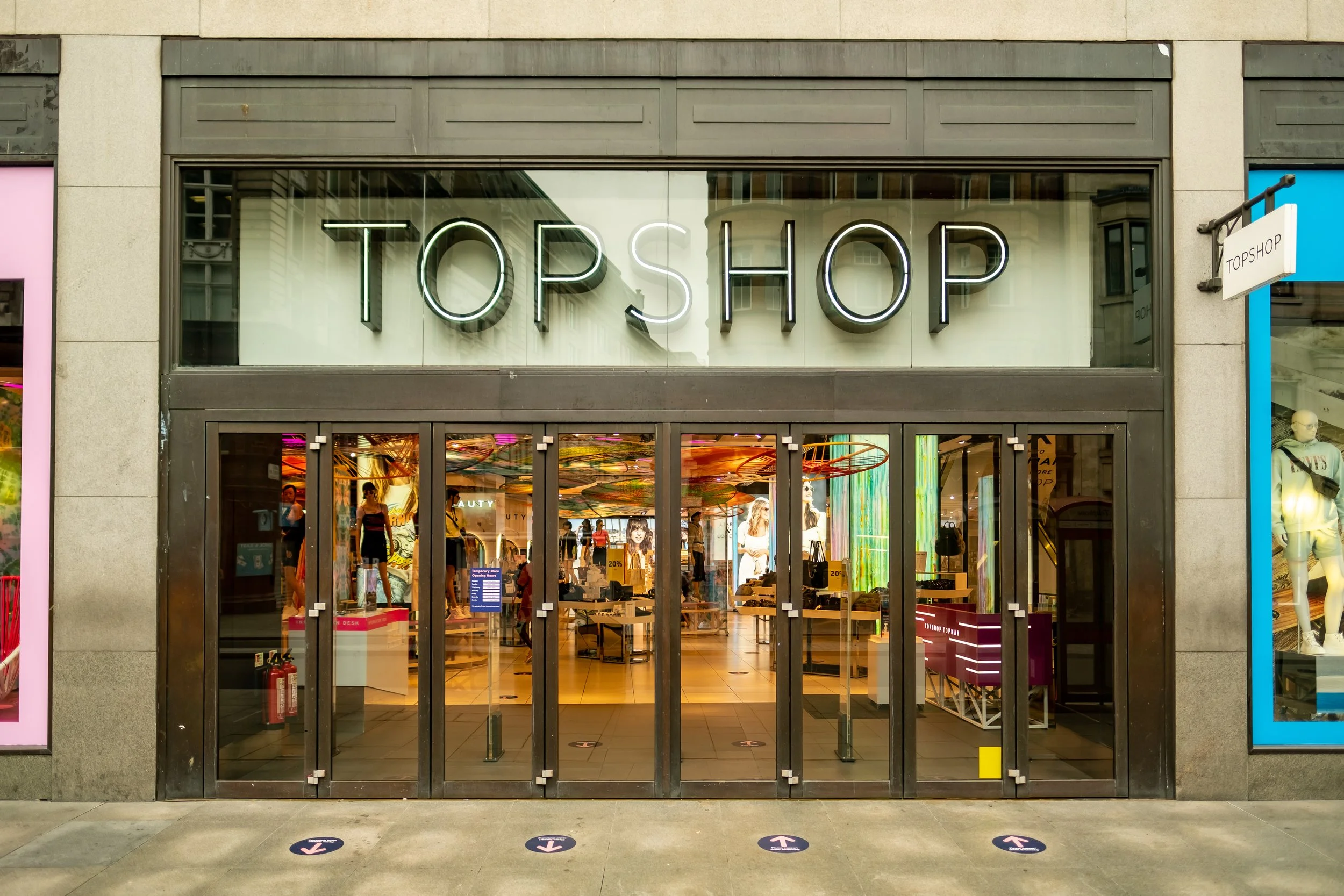
What happened to Topshop?
Topshop began in Sheffield in 1964 as a fashion proposition aimed at younger shoppers within the Peter Robinson retail business. It gradually developed into a standalone chain and, during the late 1990s, 2000s and early 2010s, became one of the defining names of British high-street fashion. Its Oxford Circus flagship, designer collaborations, relationship with London Fashion Week and hugely successful Kate Moss collections pushed it unusually close to the fashion establishment for a mass-market retailer.
Its fortunes deteriorated during the 2010s as its parent company, Arcadia Group, struggled with a large physical estate, changing consumer behaviour, intensifying online competition and repeated criticism over underinvestment. Arcadia narrowly avoided collapse through restructuring in 2019, but the COVID-19 pandemic delivered another severe blow to a business that remained heavily dependent on physical stores. The group entered administration on 30 November 2020.
ASOS acquired the Topshop and Topman brands alongside Miss Selfridge and HIIT in 2021, but it did not recreate their old store network. Topshop continued as an online fashion label before another significant ownership change in 2024, when its intellectual property was transferred into a new company majority-owned by Heartland, with ASOS retaining a minority stake and substantial licensing, ecommerce and distribution rights.
Topshop.com relaunched in Britain in 2025. By 2026, the brand had returned to physical retail through John Lewis, established dedicated ecommerce operations across much of Europe and resumed investing in campaigns, fashion events and designer collaborations. Topshop is therefore back, although what has returned is not simply the business that disappeared in 2020. A different organisation is being built around the recognition, associations and cultural memory left behind by the old one.
Before the fall, there was Big Topshop
To understand why there was something worth rebuilding, it helps to begin with Oxford Circus. Topshop's flagship opened there in 1994 and eventually occupied around 90,000 square feet, but its significance cannot be understood through retail mathematics alone. Over time, it became one of the brand's most powerful communications channels.
There were clothes, of course, but also beauty services, hair, food, music, concessions and an enormous volume of people moving continuously through the building. Teenagers travelling into London could make it the centre of a day out. Tourists knew it. Fashion editors knew it. People who had never given much thought to retail strategy still understood that the Oxford Circus Topshop was different from an ordinary branch.
Long before marketers began routinely describing shops as “brand experiences”, Topshop had constructed one several floors deep beneath Oxford Circus. The distinction matters because fashion brands are rarely built solely through logos, campaigns and product design. They are built through accumulated encounters: the bag carried down Oxford Street, the jeans tried on after school, a friend waiting beside the escalator, a song playing on the shop floor or a dress spotted on a mannequin and worn that evening. Repeated often enough, those experiences begin to form the mental architecture around a name.
Oxford Circus was therefore more than somewhere Topshop distributed stock. It was a physical expression of the brand's personality: busy, immediate, democratic, fashion-conscious and intimately associated with London. When the flagship disappeared, Topshop lost not simply valuable retail space but one of the most effective pieces of media it had ever created.
How Topshop became more than a clothes shop
Topshop's transformation into a cultural brand was not inevitable. The company had existed for decades before reaching the period for which it is now most fondly remembered, and much of its modern reputation was shaped during the tenure of Jane Shepherdson, who became brand director in 1997 and remained until 2007.
Under Shepherdson, Topshop became remarkably adept at occupying the narrow territory between mass-market accessibility and serious fashion credibility. The proposition sounded straightforward but was difficult to execute: give ordinary shoppers clothes that felt far closer to the fashion conversation than their prices suggested they should be.
Topshop was not alone in responding quickly to trends. Zara and H&M were formidable international competitors, while Britain's high street contained no shortage of fashion chains. What Topshop increasingly acquired, however, was permission to behave differently. It could work with designers, stage fashion shows, attract respected models and creatives and appear within parts of the industry usually reserved for more expensive brands.
That position became increasingly visible through Topshop's involvement with London Fashion Week. Topshop Unique joined the schedule during the 2000s and remained associated with it for more than a decade. Its front rows attracted names usually connected with luxury fashion rather than conventional high-street retail, and the effect was mutually reinforcing. The runway elevated the clothes in the stores, the scale of the stores financed greater cultural visibility, celebrities generated coverage and that coverage gave an affordable dress a different meaning from an otherwise comparable dress hanging elsewhere on the high street.
Topshop had created a remarkably effective brand loop in which commerce and culture continually strengthened one another.
When Kate Moss came to the high street
If one collaboration explains Topshop's understanding of cultural proximity, it is Kate Moss. Her first collection for the retailer launched in 2007 and attracted hundreds of shoppers to Oxford Street, some of whom had queued for hours. The excitement was not simply the result of attaching a famous name to an affordable collection. What made the partnership unusually effective was the apparent collapse of distance between an intensely observed personal style and the wardrobe of an ordinary shopper.
Celebrity collaborations have since become routine. Influencers launch product lines constantly, luxury houses collaborate with sportswear businesses and celebrities increasingly build consumer brands of their own. In 2007, however, the mechanism still had novelty, and Topshop's choice of Moss was particularly astute because the two brands already occupied compatible cultural territory. Both were British, closely associated with London, fashion-literate and influential without appearing excessively polished.
The collaboration therefore transferred meaning rather than merely attention. Topshop did not need Kate Moss simply because she was famous. It needed what she represented, and what she represented reinforced what Topshop already wanted customers to believe about itself.
That distinction remains useful for marketers today. The most valuable partnership is not automatically the one with the largest audience. It is the one capable of making the brand mean something more precise.
What Topshop was really selling
By its peak, Topshop had accumulated something more defensible than fashionable stock. It had created a network of recognisable associations around the brand: London, newness, denim, Oxford Circus, fashion-week photographs, designers, models and the promise that something recently seen in a magazine or on a celebrity might soon have an affordable counterpart on a Topshop rail.
Certain products became particularly powerful memory devices. Jeans such as Jamie and Joni remain sufficiently associated with Topshop that both have been deliberately revived during the current comeback. Their significance extends beyond individual garments. They demonstrate how particular products can become shortcuts into a larger brand memory.
This is where discussions about brand awareness can become misleading. Recognition alone is not enough. Plenty of failed companies remain well known long after they stop being commercially relevant. Useful brand equity is built from a network of recognisable and desirable associations. Customers need to understand not merely who a company is, but what role it plays in their lives.
At its strongest, Topshop answered that question quickly. If you wanted to know what fashion looked like at that moment without paying designer prices, Topshop was one of the obvious places to look. The clarity of that proposition was a large part of its power, and the gradual weakening of that clarity became one of the problems it would later face.
Why did Topshop close?
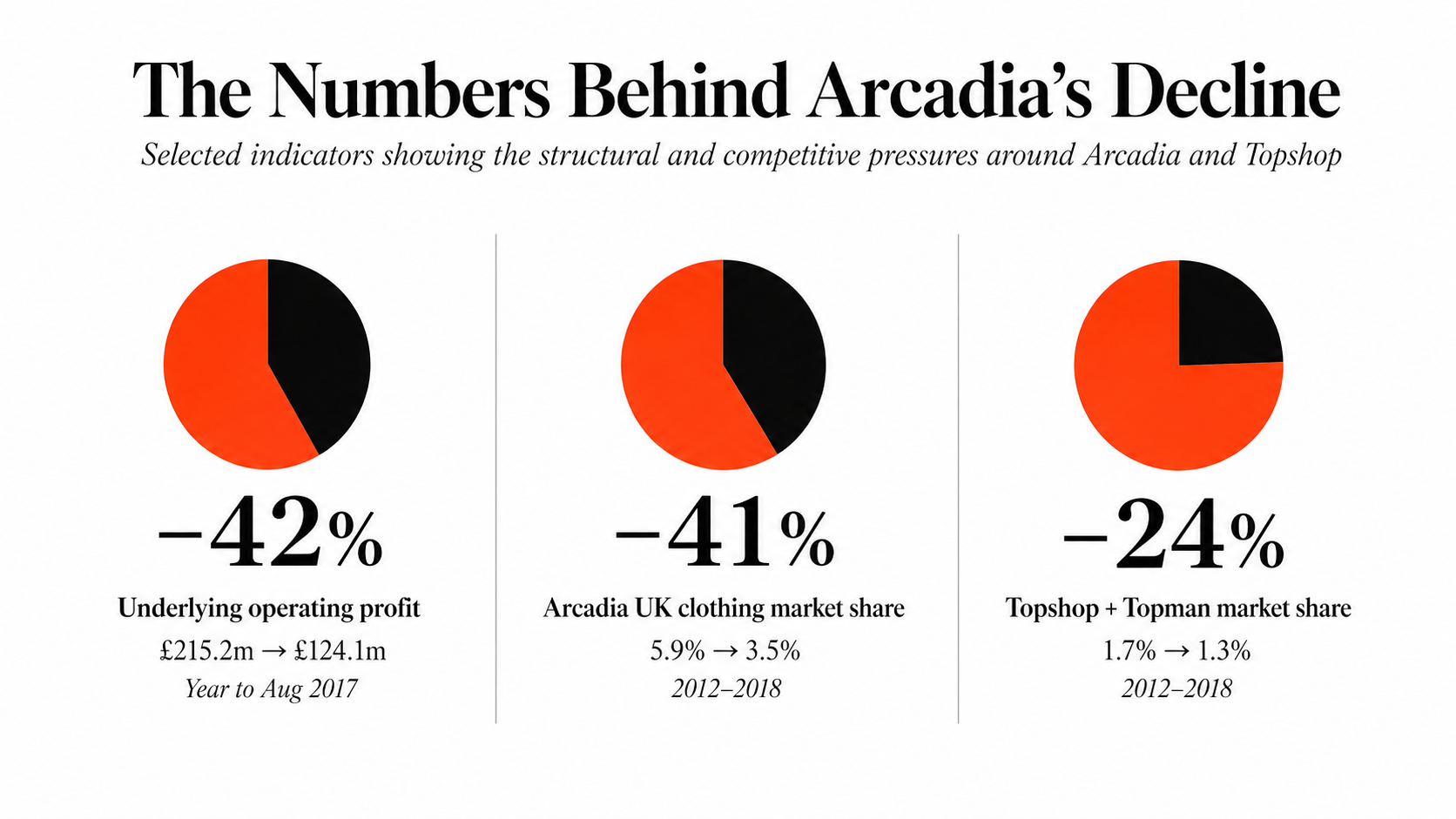
The convenient explanation is that ecommerce killed Topshop, but the reality is more complicated. Topshop's decline sat inside the much wider deterioration of Arcadia Group, which by 2019 was attempting to restructure a substantial store estate through Company Voluntary Arrangements that involved closures and significant rent reductions. Contemporary reporting repeatedly raised questions around investment, digital retail and the group's ability to keep pace with a market increasingly shaped by online competitors.
There were already signs before the pandemic that the model was under severe pressure. ASOS and Boohoo had established businesses designed around online shopping rather than adapting legacy store networks to it, while Zara and H&M had built enormously powerful international operations. Social media was altering where fashion trends originated and how rapidly they spread, and consumers no longer relied on magazines, catwalk coverage or major high-street retailers in quite the same way to translate fashion for them.
Topshop's challenge was therefore not simply technological. The cultural function it had once performed was becoming easier for other businesses and platforms to replicate. At the same time, the extensive store estate that had helped make Arcadia successful in an earlier retail environment increasingly carried costs and obligations that online-native rivals did not face to the same degree.
It is also important to distinguish between Arcadia's corporate problems and Topshop's individual loss of momentum. The two stories overlap, but they are not interchangeable. A strong brand can exist inside a weakening business, just as an efficient business can operate a brand whose cultural relevance is fading. Topshop was unfortunate enough to experience pressure from both directions.
Arcadia's 2019 restructuring bought time but did not remove all of the underlying problems. When COVID-19 forced stores to close and dramatically disrupted physical retail, the company was already vulnerable. The pandemic did not create Arcadia's weaknesses so much as accelerate their consequences, and in November 2020 the group finally entered administration.
What did ASOS actually buy?
When ASOS announced its acquisition of Topshop, Topman, Miss Selfridge and HIIT in February 2021, the headline value attached to the brands was £265 million, with additional payments relating to stock and existing commitments. The crucial detail, however, was that the transaction did not include Arcadia's stores.
That distinction shaped everything that followed. ASOS acquired intellectual property, customer awareness and fashion brands rather than attempting to recreate the physical retail business that had previously surrounded them. From ASOS's perspective, the logic was clear: it already possessed ecommerce infrastructure, fulfilment capabilities, international reach and a substantial audience of fashion consumers. Topshop could immediately benefit from those assets without the financial burden of rebuilding hundreds of shops.
Commercially, the arrangement offered obvious advantages. From a branding perspective, it also created a more complicated situation. Topshop became a label that consumers encountered inside another retailer's environment. The clothes still existed and the name remained visible, but Topshop no longer controlled the entirety of the journey around them.
Customers were no longer necessarily travelling to Topshop and discovering what Topshop wanted to show them. They were travelling to ASOS and discovering Topshop among a very large number of competing brands. For a commodity product, this difference might be relatively minor. For a brand whose previous success had depended heavily on building its own cultural world, it was far more consequential.
Topshop without Topshop
The period between Arcadia's collapse and the eventual restoration of Topshop.com may be the most revealing chapter in the company's history because it created an unusual, almost accidental experiment. What happens when a business retains the name, products and considerable awareness of a famous brand while removing much of the context that once made that brand important?
Topshop suggests that recognition can survive remarkably well even when cultural relevance becomes harder to sustain. This is useful because distribution and branding are often discussed as though they belong to separate disciplines. Distribution is treated as a commercial question, while identity and meaning are left to marketing. In practice, Topshop demonstrates how difficult it is to separate the two.
Oxford Circus was distribution, but it was also identity. Topshop.com was a sales channel, but it was also an environment over which the brand had complete control. A London Fashion Week show might have sold relatively few garments directly from the runway, yet its existence helped explain why the clothes appearing on Topshop's rails mattered.
Once enough of these contexts disappeared, the brand remained recognisable but became less vivid. Topshop did not vanish during its ASOS years, and it would be inaccurate to describe that period as dormancy. Yet the universe surrounding it had contracted. The challenge facing the people rebuilding Topshop today is effectively to make that universe expand again.
The ownership deal behind the new Topshop
Another major change arrived in 2024, when ASOS transferred the intellectual property relating to Topshop and Topman into a new company backed by Heartland A/S. The transaction completed in October 2024, leaving a Heartland subsidiary with 75 per cent of the company and ASOS with the remaining 25 per cent.
The structure is more nuanced than saying that ASOS simply sold Topshop. ASOS retains important rights relating to product design, ecommerce and distribution, including the ability to operate Topshop.com and sell the brand through ASOS. The brand-holding company, meanwhile, has its own rights around expansion, licensing and physical retail.
Today's Topshop is therefore being assembled through a deliberately different model from the Arcadia-era business. The intellectual property has a majority investor, ASOS provides substantial ecommerce and operational capability, wholesale partners create physical visibility and the brand can once again operate environments of its own.
From a branding perspective, that last point may ultimately prove the most important.
Why the return of Topshop.com matters
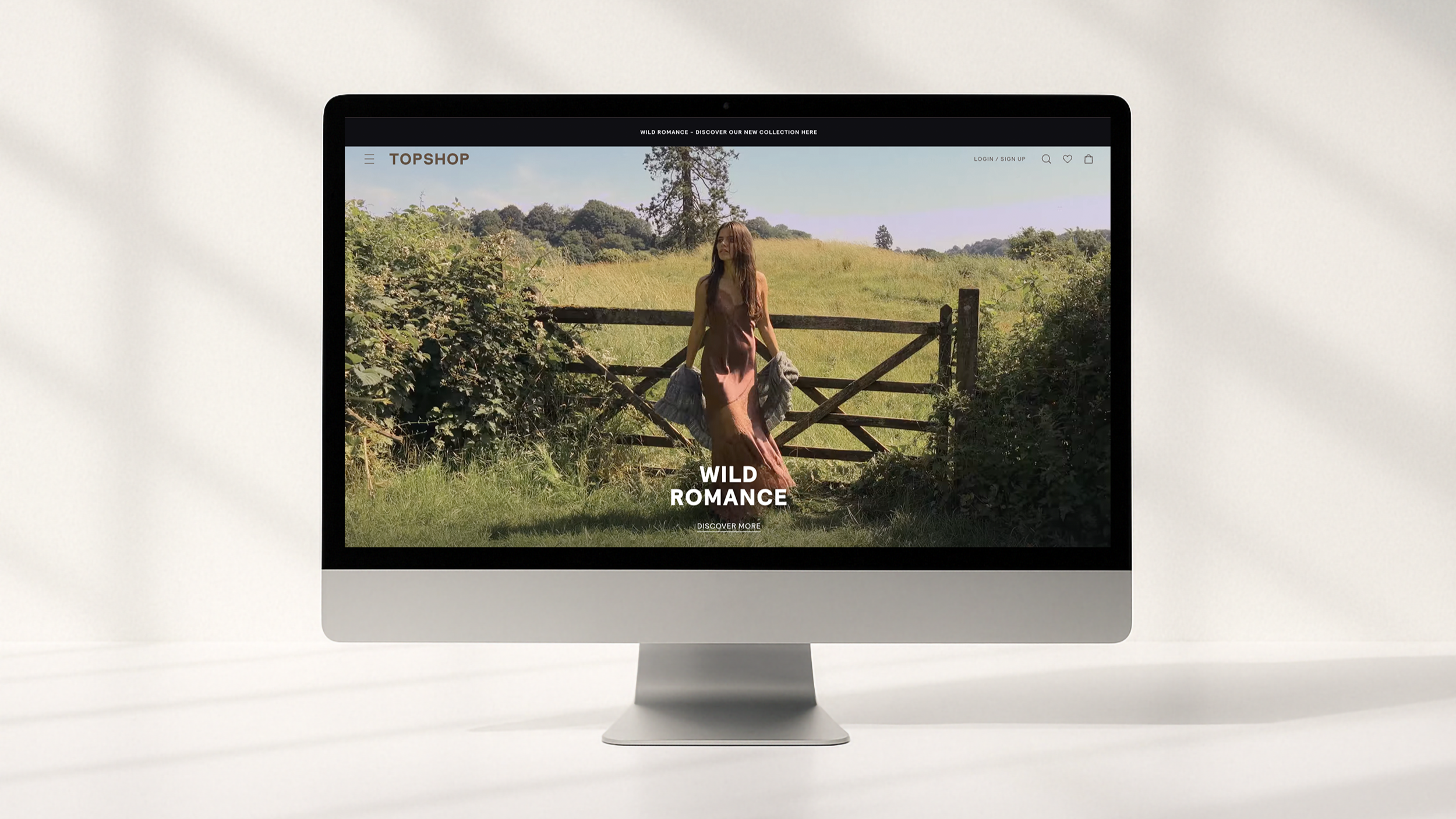
Topshop marked the return of its standalone website in August 2025 with a public runway show in Trafalgar Square. The location and format were telling. Rather than simply announcing that another ecommerce site had gone live, Topshop placed itself back in central London and once again used fashion as theatre.
The strategic importance of Topshop.com is not that customers suddenly regained the ability to buy Topshop clothes online. They had already been able to do that through ASOS. What returned was the ability for Topshop to create a complete environment around those clothes.
A standalone website determines what a visitor sees first, how collections are grouped, which campaigns are given prominence, what stories are told and how the brand presents itself before a customer reaches a product page. It also allows Topshop to cultivate a more direct relationship with its audience rather than relying entirely upon somebody else's retail environment.
Seen in that context, the restoration of Topshop.com is less about a URL than about control. Topshop had continued to possess distribution after the ASOS acquisition. What it had largely lost was the ability to function as a destination in its own right. The new website is an attempt to restore that distinction.
Rebuilding Topshop without pretending it is still 2007
The most obvious danger facing any revived fashion brand is nostalgia. Familiarity can generate attention remarkably efficiently, but it can also trap a company inside the era in which it was last culturally significant.
Topshop's new strategy makes frequent use of its heritage. Cara Delevingne returned to the brand's orbit during the Topshop.com launch, reconnecting the contemporary business with a model strongly associated with its previous era. Jamie and Joni jeans have returned, and other historic codes are being carefully reintroduced.
The more interesting elements of the comeback, however, are those that attempt to restore the mechanisms through which Topshop once became relevant rather than simply reproducing the artefacts of its past. The company has resumed working with emerging designers, including an 18-piece collaboration with British-Nigerian designer Tolu Coker, while Central Saint Martins students have been invited to reinterpret some of its best-known denim styles. Adwoa Aboah has also fronted a major campaign.
This approach feels more faithful to what made Topshop important in the first place. The old brand did not become successful because it constantly reminded shoppers of its previous successes. It became successful by attaching itself to whatever seemed culturally alive at that particular moment. If the new Topshop can rediscover that instinct, its heritage becomes useful raw material rather than a set of instructions.
From Oxford Circus to Liberty and John Lewis
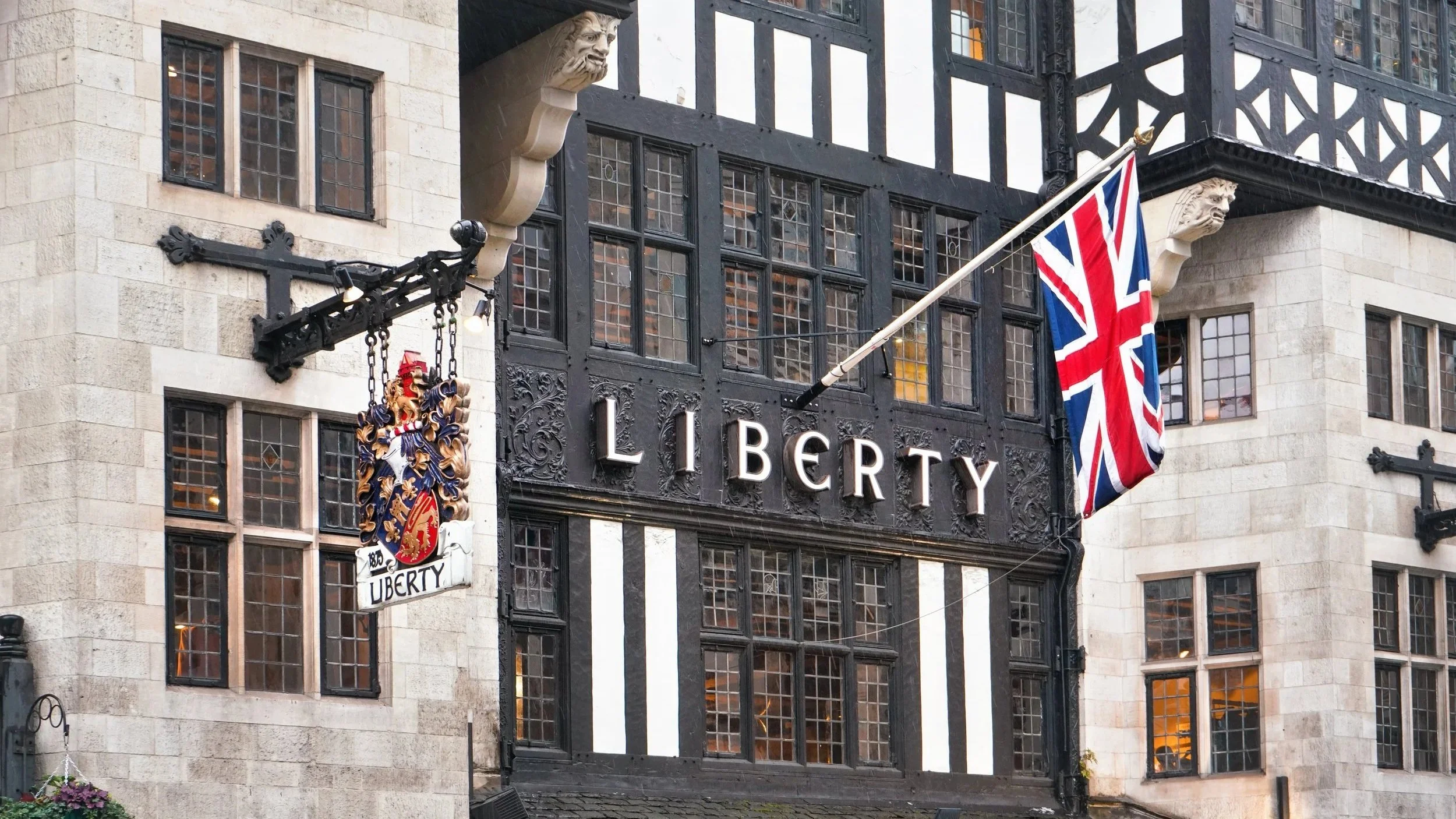
Topshop's return to physical retail has so far been considerably more cautious than its former model. It initially reappeared through a partnership with Liberty, only a short distance from the Oxford Circus store that had once defined it, before launching temporary John Lewis pop-ups and eventually expanding into 32 John Lewis stores around the UK in February 2026.
This is not an attempt to recreate the old Arcadia estate, and that difference appears deliberate. Topshop gains physical presence, fitting rooms, immediate product availability and access to established high-street footfall without immediately assuming the costs and risks involved in rebuilding a national network of standalone shops.
The arrangement reflects a wider change in what physical retail can mean for a fashion brand. Topshop no longer needs every shop carrying its name to belong to it. Wholesale and concession partnerships can provide a physical layer around a predominantly digital business while allowing the brand to test where demand exists.
What such spaces cannot easily reproduce is the emotional intensity of Big Topshop, but recreating Oxford Circus may not be the objective. A successful revival does not require every historical asset to return exactly as it was. It requires an understanding of the role those assets played and a contemporary way of performing the same function.
Oxford Circus created discovery, social energy, cultural visibility and scale. The challenge is to determine how many of those qualities can now be produced through a combination of digital platforms, events, partnerships, campaigns and selective physical retail.
From Britain back into Europe
Topshop's digital reconstruction has also expanded beyond Britain. In January 2026, a dedicated European website launched across 23 EU countries, including France, Germany, Italy and Spain, with Ireland following later in the year. Topshop remains available through ASOS, meaning the company now combines multi-brand distribution with standalone digital destinations.
The distinction once again comes back to context. A product available through ASOS may reach an enormous audience, but a dedicated Topshop platform can present the brand through its own campaigns, merchandising, editorial choices, newsletters and product launches. It can create a clearer argument for why Topshop exists rather than relying purely on whether an individual item appears attractive in a marketplace.
That difference is strategically important because the renewed Topshop is not competing only for transactions. It is competing to become meaningful again.
Can nostalgia actually sell clothes?
The revived Topshop has one advantage that an emerging fashion brand could never purchase from scratch: millions of people already know its name. Many have specific emotional associations with it and can remember precisely which jeans they owned, where their nearest branch was or what it felt like to descend into Oxford Circus.
That accumulated memory is valuable, but it is not the same thing as demand. There is a significant commercial difference between a former customer saying, “I used to love Topshop,” and deciding, “I want to buy something from Topshop today.” Nostalgia can generate the first visit, provide a powerful reason for journalists to cover the comeback and make the return of products such as Jamie jeans feel culturally loaded in a way that an entirely new style would not.
What nostalgia cannot do is make the clothes desirable indefinitely. It cannot guarantee fit, quality, value or relevance, and it cannot automatically explain to a 20-year-old shopper with no memory of Big Topshop why this brand should matter more than Zara, COS, H&M, Mango, ASOS, Depop, Vinted, Uniqlo or the endless stream of labels encountered through social media.
The long-term challenge is therefore generational as much as commercial. Topshop must retain the affection of people who remember what it was while creating enough contemporary relevance for people who do not. Its historic reputation may open the door, but the product, price, service and cultural positioning of the new business will determine whether customers continue walking through it.
What the Topshop story tells us about brand equity
Businesses are accustomed to measuring what they own: buildings, stock, revenue, customers, intellectual property, contracts and data. A brand complicates that calculation because a meaningful proportion of its value exists outside the company altogether, in the memories and associations held by other people.
Topshop's old stores could close, its employees could leave, its corporate parent could enter administration, its independent website could disappear and its flagship could eventually be occupied by IKEA. None of those events could instantly remove what millions of people already associated with the Topshop name.
This does not mean that brand love is permanent or that awareness guarantees commercial success. It means that different assets decay at different speeds. Physical distribution can disappear almost overnight, while mental availability and cultural memory may survive for years. The gap between those two rates of decay is what created the possibility of Topshop's second life.
The story also demonstrates why physical environments should sometimes be understood as brand assets rather than merely property. Oxford Circus mattered because experiences accumulated there over decades, turning a shop into part of the meaning of Topshop itself. It shows why distribution affects perception, because buying Topshop inside ASOS was commercially useful but psychologically different from entering an environment controlled entirely by Topshop. It also reinforces the value of collaboration when the partner contributes the right cultural meaning rather than simply a large audience.
Perhaps most importantly, Topshop illustrates the difference between heritage and strategy. Heritage can provide recognition, distinctive assets and stories worth recovering, but it cannot tell a company what to do next. The new brand has to decide which parts of the old Topshop still possess value and which belong to a retail and cultural environment that no longer exists.
Is Topshop really back?
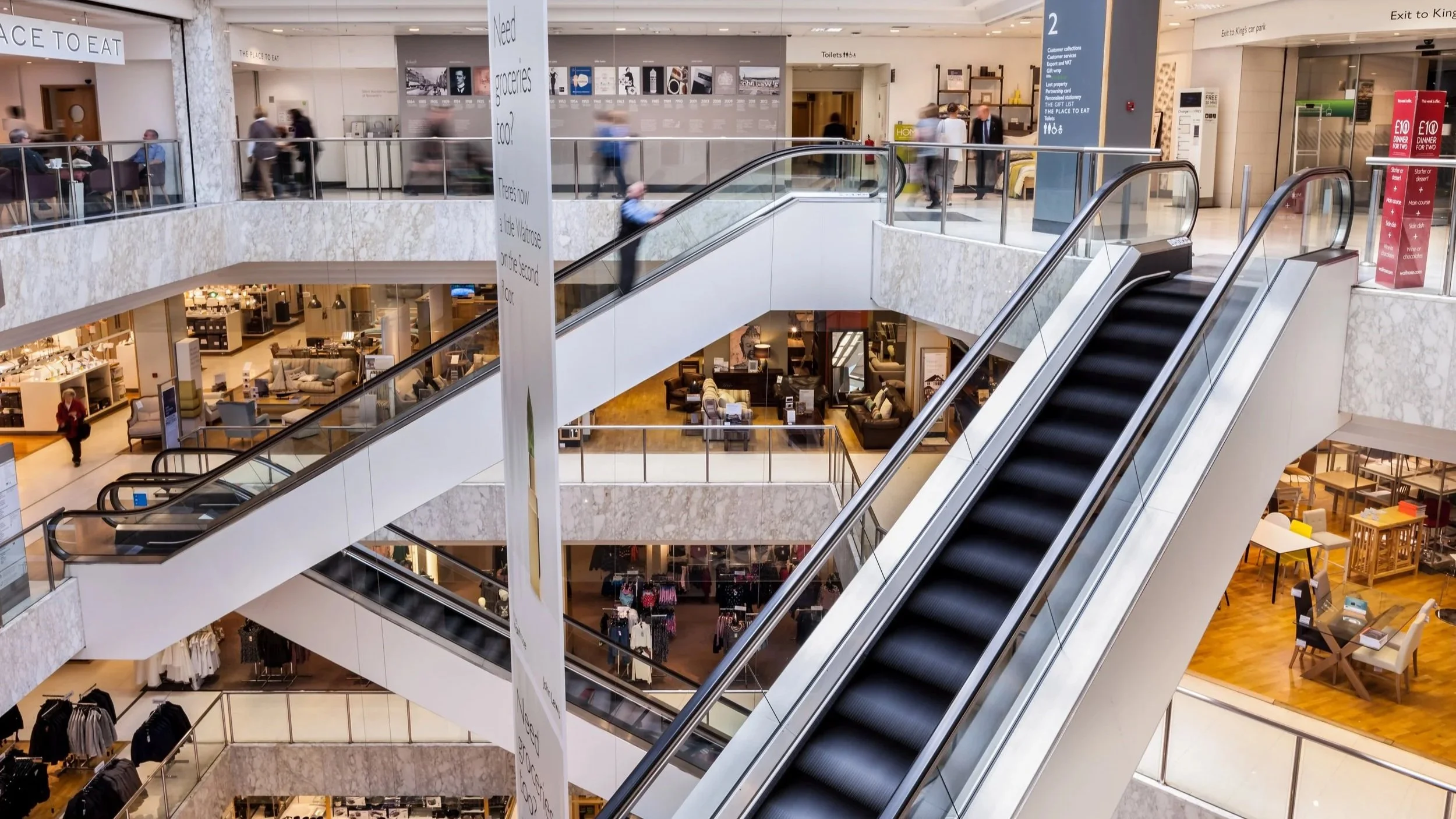
Topshop is back in a literal sense. It once again has its own UK website, dedicated ecommerce operations across much of Europe, a growing physical presence through John Lewis and renewed activity across campaigns, fashion events and collaborations. What has not returned is the Topshop empire that once lined British high streets and turned Oxford Circus into a destination in its own right.
That distinction makes the current chapter considerably more interesting than a conventional retail revival. The competitive landscape has changed, the economics of physical retail have changed and the fashion customer has changed. Big Topshop now belongs to IKEA, while many of the cultural mechanisms that helped make the old Topshop powerful have migrated onto social platforms, resale marketplaces and entirely new forms of retail.
Yet Topshop begins this second life with something most new brands spend years attempting to create. For a period, it occupied a clear and emotionally meaningful place in people's understanding of fashion. It helped translate the fashion establishment for the high street, gave affordable retail unusual cultural credibility and turned a shop in central London into part of British popular culture.
The infrastructure that produced those associations eventually collapsed, but the associations themselves did not disappear at the same speed. A different business is now being assembled around what remains, making Topshop less a story about a company returning from the dead than a live experiment in whether brand equity can outlive the organisation that originally created it.
Topshop has already demonstrated that a brand can survive the disappearance of its stores, its former owner and much of its original distribution. The more difficult question is whether remembered relevance can be converted into contemporary relevance. That is the part of the Topshop story that has yet to be written.
Topshop FAQs
Is Topshop back?
Yes. Topshop relaunched its standalone UK website in 2025 and has since expanded both its digital and physical presence. The brand is stocked through John Lewis in the UK, operates dedicated ecommerce sites across Britain and a growing number of European markets and continues to be sold through ASOS.
Who owns Topshop now?
Topshop's intellectual property is held through a company in which a Heartland subsidiary owns 75 per cent and ASOS owns 25 per cent. ASOS also retains substantial rights relating to product design, ecommerce, licensing and distribution, so the current ownership structure is more complex than describing Topshop as belonging solely to either company.
Does ASOS still own Topshop?
ASOS still owns a 25 per cent interest in the company holding the Topshop and Topman intellectual property. It also retains important licensing and operational rights, including the ability to design and distribute Topshop products, operate Topshop.com and continue selling the brand through ASOS.
Why did Topshop close?
Topshop's stores closed following the collapse of its parent company, Arcadia Group, which entered administration in November 2020. Arcadia had already been struggling with financial pressure, an extensive store estate, changing consumer habits, digital competition and criticism over underinvestment before the COVID-19 pandemic placed further pressure on the business.
When did Topshop close?
Arcadia Group entered administration on 30 November 2020 and Topshop's Arcadia-operated store network subsequently closed as the company's assets were sold. ASOS acquired the Topshop brand in February 2021 but did not purchase its physical store estate.
What happened to Topshop Oxford Circus?
Topshop's famous Oxford Circus flagship closed following the collapse of Arcadia. IKEA's parent company later acquired the building and, after a lengthy redevelopment, opened IKEA Oxford Street there in May 2025.
When did ASOS buy Topshop?
ASOS announced its acquisition of Topshop, Topman, Miss Selfridge and HIIT from Arcadia's administrators on 1 February 2021. The transaction focused on the brands and related assets rather than the former Arcadia store network.
How much did ASOS pay for Topshop?
The Topshop, Topman, Miss Selfridge and HIIT brands were valued at £265 million in ASOS's 2021 transaction with Arcadia's administrators. ASOS also paid additional sums relating to inventory and purchase commitments.
When did Topshop.com return?
Topshop marked the return of its standalone website in August 2025 with a public fashion event in Trafalgar Square. The website forms part of a broader strategy to establish Topshop again as a destination in its own right rather than solely a label distributed through ASOS.
Is Topshop back on the UK high street?
Yes, although not through a recreated network of standalone Topshop stores. After initial physical retail partnerships and pop-ups, Topshop expanded into 32 John Lewis stores around the UK in February 2026.
Why was Topshop so popular?
Topshop combined accessible pricing with unusually strong fashion credibility. Its Oxford Circus flagship became a destination, while London Fashion Week appearances, designer partnerships and collaborations such as Kate Moss allowed it to participate in fashion culture in a way that few conventional high-street retailers managed.
Can you still buy Topshop on ASOS?
Yes. Topshop continues to be sold through ASOS alongside the brand's standalone ecommerce operations. This gives Topshop both access to ASOS's large audience and greater control over its own presentation through Topshop.com.