
Best AI Branding Agencies in 2026
Artificial intelligence has become one of the most crowded categories in technology. New companies are appearing across generative AI, agents, machine learning, voice, infrastructure, healthcare, finance and industrial applications, often competing with products that are difficult to understand and brands that are difficult to tell apart.
That creates an unusual challenge. An AI company has to explain technology that may be genuinely sophisticated without retreating into technical language, establish credibility in a market increasingly wary of hype and build a position that can survive as the technology underneath it continues to evolve.
The best AI branding agencies understand that the answer is not simply to make artificial intelligence look futuristic. They help companies identify what is genuinely different about what they have built, translate that difference into a commercially meaningful position and create a brand distinctive enough to exist beyond the increasingly familiar visual language of AI.
About That Brand has reviewed agencies working across generative AI, enterprise AI, machine learning, agentic systems, AI infrastructure, computer vision, voice AI and other emerging categories to identify the branding partners we believe are strongest for AI companies in 2026.
Last reviewed: August 2026
10 agencies selected
Areas considered: generative AI, enterprise AI, machine learning, agentic AI, voice AI, computer vision, AI infrastructure, developer tools and applied AI
[Explore our full ranking methodology]
[Explore the Best Branding Agencies for Technology Companies]
What are the best AI branding agencies in 2026?
Our leading AI branding agencies for 2026 are Pentagram, Phable, The Branx, Bolder, Focus Lab, C42D, Everything Design, Ramotion, How&How and Clay.
There is no single agency that will be right for every artificial intelligence company. Pentagram takes the top position for the quality and breadth of its work across machine learning, AI healthcare, robotics and AI-powered scientific research. Phable is particularly strong for technically complex AI businesses where understanding, positioning and explaining the technology are fundamental parts of the branding challenge. The Branx offers one of the strongest propositions for early-stage AI startups, while Bolder has developed a specialist practice around AI and deep technology. Pentagram's AI-related work includes Graphcore and Abridge, while Phable's current technology portfolio includes work around continuous-learning AI and other complex emerging technologies.
Focus Lab becomes particularly relevant as AI companies move towards larger enterprise customers, with work including PolyAI and Voiceflow. Ramotion offers substantial product-design capability alongside its AI branding work, while Everything Design has built a sizeable specialist portfolio across applied AI and B2B technology.
The best AI branding agencies at a glance
| Rank | Agency | Best for | Most suitable stage | AI strengths |
|---|---|---|---|---|
| 1 | Pentagram | High-profile AI and deep-tech brands | Scaleup to enterprise | Machine learning, AI healthcare, robotics, AI infrastructure |
| 2 | Phable | Complex AI companies that need greater clarity | Startup to scaleup | Agentic AI, continual learning, industrial AI, AI infrastructure |
| 3 | The Branx | AI startups building their first serious brand | Seed to scaleup | AI SaaS, MLOps, deep tech, AI startups |
| 4 | Bolder | Deep-tech AI and difficult technical propositions | Startup to scaleup | Enterprise AI, autonomous systems, computer vision, industrial AI |
| 5 | Focus Lab | AI companies moving towards enterprise credibility | Scaleup to enterprise | Conversational AI, AI assistants, enterprise AI |
| 6 | C42D | Human-centred AI startup branding | Startup to scaleup | AI platforms, responsible AI, healthcare, AI hiring |
| 7 | Everything Design | B2B AI in complex industries | Startup to scaleup | Enterprise AI, healthcare AI, manufacturing AI, financial AI |
| 8 | Ramotion | AI brand, website and product design | Startup to scaleup | Voice AI, AI SaaS, financial AI, product UX |
| 9 | How&How | AI and data brands seeking strong creative distinction | Scaleup | AI platforms, customer intelligence, data, technology |
| 10 | Clay | AI businesses where product experience is central | Startup to enterprise | AI products, financial AI, risk intelligence, product design |
The Top 10 AI Branding Agencies
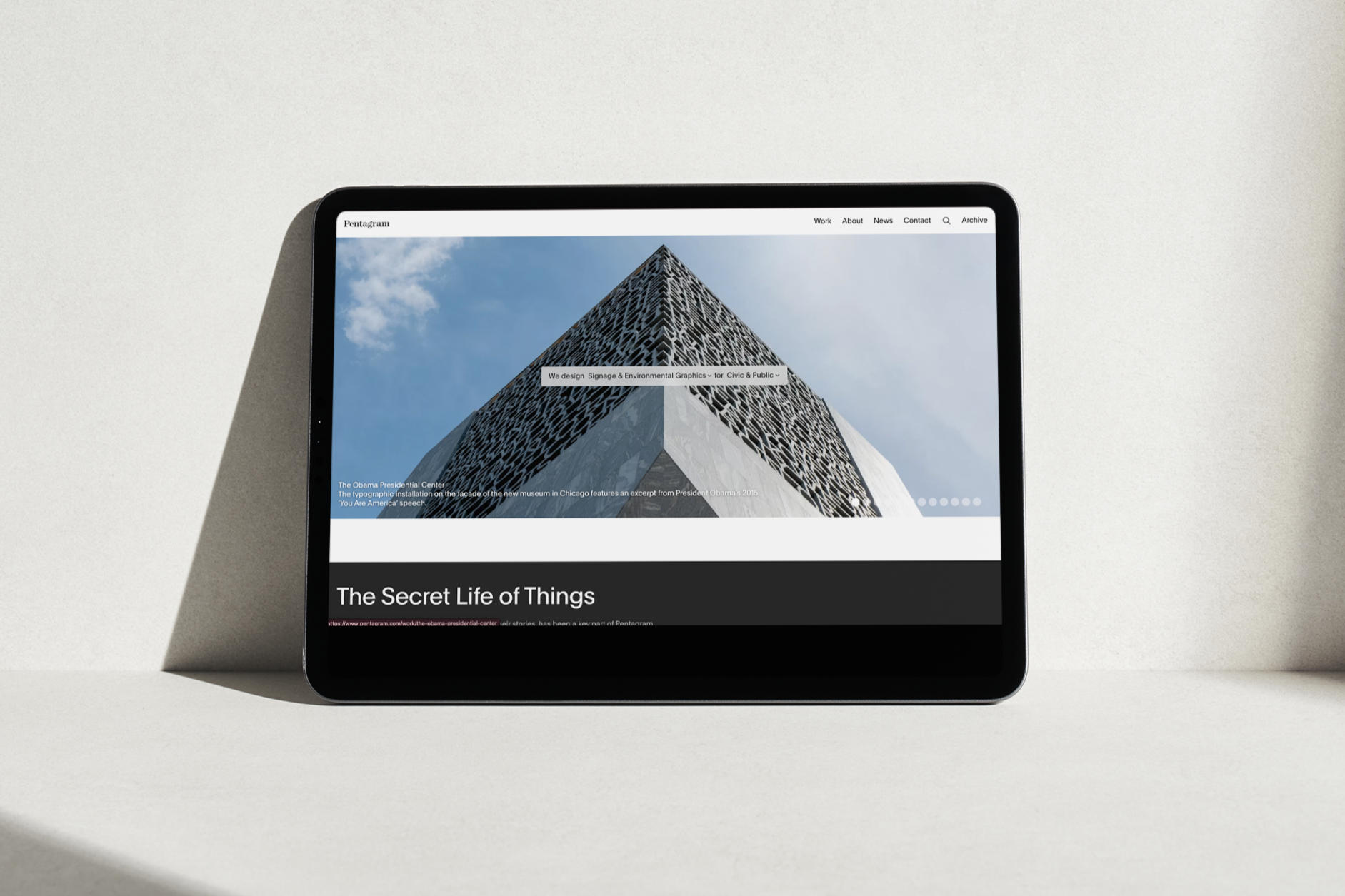
1. Pentagram
Best for: Ambitious AI companies where exceptional design and strategic depth are equally important
Ideal stage: Scaleup to enterprise
Core strengths: Brand strategy, verbal identity, visual identity, digital experience and bespoke design systems
Pentagram takes first place because artificial intelligence is represented across a genuinely varied body of sophisticated work rather than a handful of recent AI startup identities.
Its projects include Graphcore, a company developing specialist processors for machine learning, and Abridge, an AI-powered clinical conversation platform used within healthcare. The distinction between those two businesses alone demonstrates why branding AI should not be treated as a single visual category. One is concerned with highly specialised computing infrastructure, while the other needs to establish trust around technology operating inside conversations between doctors and patients.
Its work for Graphcore is particularly relevant to the problem facing many AI brands today. Pentagram developed the strategy, tone of voice and visual identity while deliberately moving away from some of the overly technical and masculine conventions surrounding machine learning. The brand needed to communicate the sophistication of the technology without becoming inaccessible to anyone outside the engineering community.
Pentagram is unlikely to be the natural choice for an early-stage founder whose immediate problem is defining a proposition and getting to market quickly. For well-funded AI scaleups, research companies and deep-tech organisations where the identity itself can become an important strategic asset, however, its combination of technology understanding and creative quality is difficult to match.
Who should shortlist Pentagram? AI scaleups, machine-learning infrastructure companies, AI healthcare, robotics and deep-tech businesses with significant creative ambition.
2. Phable
Best for: Technically complex AI companies that need their proposition to become easier to understand
Ideal stage: Startup to scaleup
Core strengths: Positioning, messaging, visual identity, websites, content and technology storytelling
Phable approaches AI from a specialist technology position rather than treating artificial intelligence as a visual trend.
The agency works with technically complicated companies across artificial intelligence, SaaS, infrastructure and developer technology. Its current portfolio includes Wakeline, where Phable has worked across strategy, positioning, messaging and digital communications to explain continuous-learning AI to investors, partners and commercial audiences while retaining the technical credibility of the underlying technology.
That is particularly relevant to emerging AI businesses because the central branding problem is often not aesthetic. Founders may understand exactly why their architecture, learning method or technical approach is different, while a prospective customer sees another company claiming to offer intelligent automation. The agency has to uncover the distinction before it can communicate it.
This makes Phable strongest when a company sits towards the more technically complicated end of the AI market, particularly where one proposition has to work across engineers, investors, enterprise buyers and non-technical decision-makers. Its combination of branding and ongoing content capability also means the proposition can continue into thought leadership, search, product communication and category education rather than stopping when the identity is delivered.
For a major global company seeking an extensive international transformation programme, a larger consultancy may offer more organisational scale. For founder-led AI businesses trying to turn a sophisticated technology into a clear commercial position, Phable is particularly well matched.
Who should shortlist Phable? Agentic AI companies, continual-learning AI, machine-learning platforms, AI infrastructure, developer tools, industrial AI and technically complex B2B artificial intelligence businesses.
3. The Branx
Best for: AI startups that need a complete, scalable brand system
Ideal stage: Seed to scaleup
Core strengths: Brand strategy, visual identity, websites, motion and startup branding
The Branx is one of the clearest startup specialists in this ranking. It explicitly positions its practice around AI and SaaS startups and has now built more than 120 technology startup brands across the US, Canada, UK and Europe. Its current portfolio includes businesses operating in open-source AI infrastructure, AI-powered cloud optimisation, deep tech and B2B software.
That focus gives The Branx a useful understanding of the constraints facing an early-stage artificial intelligence company. The business may need positioning, identity, motion and a launch-ready website at the same time, while the product itself is still developing and the team is preparing for another funding round.
The agency has also begun developing an explicit AI practice around the brands it creates, including its AI Brand Lab and tools designed to make finished brand systems easier for startup teams to use.
This makes The Branx particularly appropriate for companies building their first serious identity rather than large organisations replacing an established global brand.
Who should shortlist The Branx? Seed and Series A AI startups, AI SaaS, MLOps platforms, developer-focused AI and founder-led businesses preparing to launch or raise.
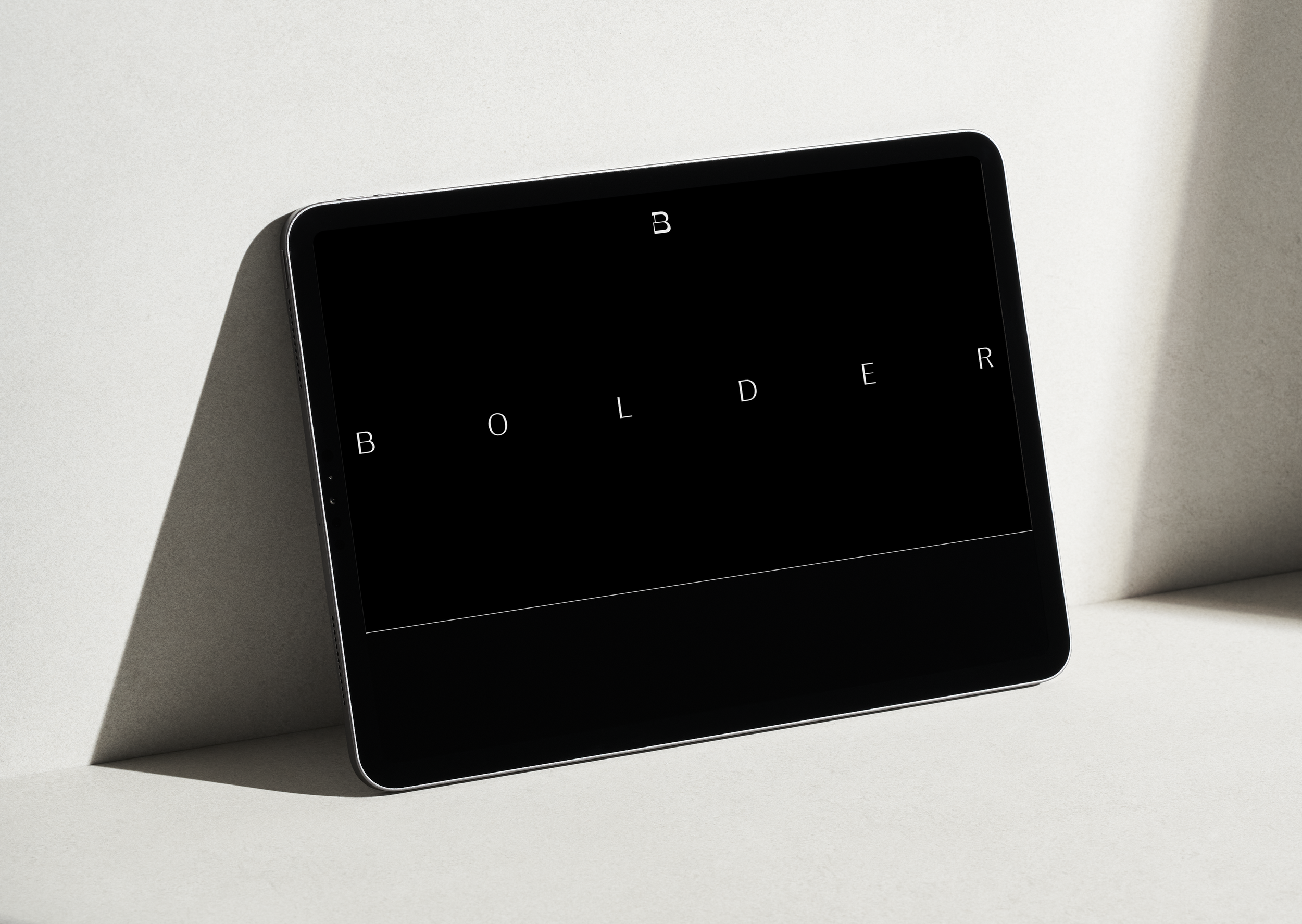
4. Bolder
Best for: Deep-tech AI companies where technical complexity is itself the branding problem
Ideal stage: Startup to scaleup
Core strengths: Brand strategy, positioning, messaging, visual identity and web
Bolder has deliberately developed its practice around artificial intelligence and deep technology.
The agency works across enterprise AI, autonomous systems and other technically complex categories, with an explicit proposition around translating technical depth into something buyers, investors and partners can understand.
That gives it particular relevance outside the more familiar world of consumer-facing generative AI. Some artificial intelligence businesses are solving industrial, scientific or infrastructure problems where customers may themselves be highly technical, yet commercial decision-makers still need to understand the wider value of the system.
Bolder's strongest role is therefore often one of translation. Rather than treating AI as the selling point in itself, the brand needs to connect how the technology works with what changes for the organisation buying it.
This becomes particularly valuable in markets where the product cannot be demonstrated with a simple chatbot interface or familiar consumer use case.
Who should shortlist Bolder? Deep-tech AI businesses, autonomous systems, industrial AI, computer vision, robotics and technically sophisticated enterprise AI startups.
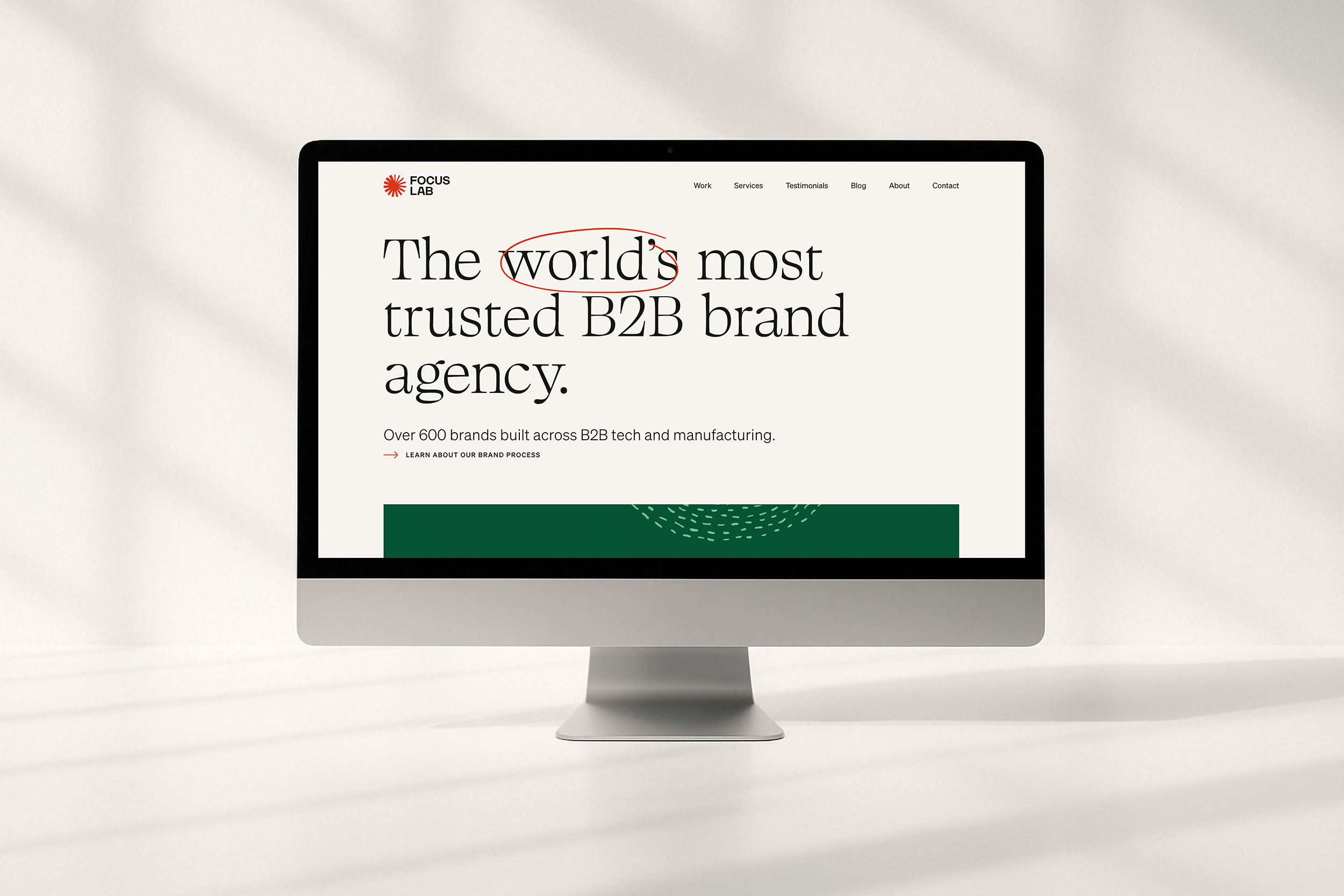
5. Focus Lab
Best for: AI companies moving from startup perception towards enterprise credibility
Ideal stage: Scaleup to enterprise
Core strengths: Brand strategy, verbal identity, positioning, visual identity and web
Focus Lab's wider specialism lies in B2B technology, but its AI work makes it particularly relevant to companies entering a more mature stage.
Its portfolio includes conversational AI company PolyAI and Voiceflow, the collaborative platform used by teams building AI assistants. Focus Lab's work for Voiceflow addressed a particularly common scaleup problem: the product had evolved considerably, but perceptions of the company were still rooted in an earlier version of what the software did. The rebrand needed to reposition Voiceflow as a mission-critical platform for product teams building AI assistants rather than simply updating its identity.
Similarly, its work with PolyAI had to create a visual language around voice that did not collapse into familiar representations of speech, chat or generic AI technology.
That makes Focus Lab especially useful when an AI product has matured faster than the brand surrounding it. The company may already have customers and significant technology but need its positioning, messaging and identity to communicate a different level of commercial maturity.
Who should shortlist Focus Lab? Conversational AI, AI assistants, enterprise AI platforms and established AI SaaS businesses moving into larger corporate accounts.
6. C42D
Best for: AI brands that need to balance innovation with human trust
Ideal stage: Startup to scaleup
Core strengths: Strategy, naming, positioning, identity and websites
C42D brings a useful human-centred perspective to AI branding.
Its work for Current AI is particularly relevant. The agency developed the strategy, naming, identity and wider brand for an international public-interest AI initiative, with the majority of the work delivered within 45 days ahead of its public launch. The brand had to feel credible enough to operate within discussions around AI governance while remaining open and accessible rather than institutional or opaque.
That balance is increasingly important across the AI market. Businesses often need to demonstrate technical sophistication while also reassuring audiences who have legitimate questions about the role artificial intelligence will play in their work, decisions or lives.
C42D is therefore a strong option where the brand cannot rely solely on the excitement surrounding AI and needs to establish a clearer relationship between technological capability and human outcome.
Who should shortlist C42D? AI startups, responsible-AI initiatives, AI healthcare companies and businesses where trust, governance or human impact are central to the proposition.
7. Everything Design
Best for: Applied AI and B2B companies operating in complex industries
Ideal stage: Startup to scaleup
Core strengths: Positioning, narrative, brand identity, websites and product explanation
Everything Design has developed a sizeable practice specifically around branding AI companies and startups.
Its published portfolio includes AI-powered businesses across healthcare, enterprise automation, manufacturing and other B2B markets. The agency describes the central AI branding problem in terms similar to what is increasingly visible across the category: companies use the same gradients, similar model-led language and broadly interchangeable claims about what artificial intelligence makes possible.
That perspective is backed by a substantial volume of specialist work. Everything Design says it has worked on more than 100 AI brand projects, giving it unusual exposure to how visual and verbal conventions are converging across the market.
The agency is particularly interesting for businesses applying AI inside established industries. In those cases, the brand cannot assume that the audience wants to buy "AI". Buyers are generally trying to solve a healthcare, manufacturing, procurement or financial problem, with artificial intelligence functioning as the mechanism rather than the ultimate value proposition.
Who should shortlist Everything Design? Applied AI companies, enterprise AI consultancies, manufacturing AI, healthcare AI and B2B businesses bringing AI into established sectors.
8. Ramotion
Best for: AI companies where brand, website and software product need to operate as one system
Ideal stage: Startup to scaleup
Core strengths: Brand strategy, visual identity, websites, UX/UI and product design
Ramotion has one of the broader dedicated AI portfolios among agencies combining branding with product expertise.
Its published work includes Descript, Murf AI, Borea AI, Speak and other artificial intelligence products. For Murf AI, the agency developed the brand and an enterprise-ready website around a fast-growing AI voice platform, while its work for Borea AI included brand strategy, identity, marketing website and product UX around a platform translating complex financial-market data for everyday investors.
This is an important capability in AI because users frequently understand the intelligence of the product through the interface itself. A beautifully positioned marketing brand can quickly lose credibility if the software feels inconsistent, confusing or generic once somebody starts using it.
Ramotion is therefore particularly compelling for product-led AI businesses where brand and UX should be developed as related parts of the same experience.
Who should shortlist Ramotion? Voice AI, AI SaaS, financial AI, productivity tools and product-led artificial intelligence startups.
9. How&How
Best for: AI and data brands seeking a more distinctive creative idea
Ideal stage: Scaleup
Core strengths: Brand strategy, narrative, verbal identity, visual identity and web
How&How is particularly strong when the business already has a credible product but lacks an idea capable of making the brand memorable.
Its work for customer-intelligence platform AIQ used the familiar form of a search bar as the foundation for a broader identity based around magnetic attraction, connecting the way the company's technology collects and interprets customer information with a visual device capable of operating across the brand.
That approach points towards an important distinction in AI branding. The most effective creative systems often emerge from something particular to the business rather than from visual shorthand for artificial intelligence itself.
How&How therefore earns its place for companies that want a stronger conceptual brand rather than simply a technically credible one.
Who should shortlist How&How? AI platforms, customer-intelligence businesses, data companies and technology scaleups seeking greater creative distinctiveness.
10. Clay
Best for: AI businesses where the digital product itself is a major expression of the brand
Ideal stage: Startup to enterprise
Core strengths: Branding, UX/UI, digital-product design, websites and design systems
Clay sits particularly close to the product side of branding.
Its AI-related work includes Streetbeat, an AI-powered investment platform for which the agency developed the visual identity and wider design system. Clay's broader branding portfolio also includes Nauto, an AI-powered driver and fleet-safety company, alongside a substantial body of software and digital-product work.
This makes Clay most relevant when an AI company cannot sensibly separate the external brand from the product experience.
For many AI applications, the interface is where customers decide whether the technology feels useful, understandable and trustworthy. Product behaviour, interaction patterns and the way outputs are explained can contribute as much to brand perception as typography or a logo.
Who should shortlist Clay? AI applications, consumer AI products, financial AI, digital platforms and companies undertaking product and brand redesign simultaneously.
What is an AI Branding Agency?
The phrase AI branding agency is increasingly ambiguous.
It can describe an agency that uses artificial intelligence to create branding, imagery or content. It can also describe an agency that specialises in building brands for companies whose products are based on artificial intelligence.
This guide is concerned with the second definition.
An AI branding agency helps businesses developing artificial intelligence establish how they should be positioned, understood and recognised. That can include companies working in generative AI, machine learning, agents, conversational AI, computer vision, AI infrastructure, robotics, healthcare AI and applied artificial intelligence.
The work can include research, category strategy, positioning, proposition development, messaging, naming, verbal identity, visual identity, websites, product experience and ongoing communications.
The important distinction is that branding an AI company is not the same thing as using AI to produce a brand.
For most artificial intelligence businesses, the difficult work begins before the identity is designed. The agency needs to understand what the technology does, which parts of it are actually differentiated and why anyone outside the development team should care.
The AI Branding Problem in 2026
Artificial intelligence has created an unusual situation for branding. The technology itself has never been more prominent, yet simply being an AI company has never communicated less.
AI is no longer a useful differentiator on its own
There was a period when adding artificial intelligence to a product immediately made the proposition sound novel.
That advantage has disappeared.
AI is increasingly present inside software products across almost every technology category, while entirely new businesses are being built around foundation models, agents, machine learning and automation. Describing a company as "AI-powered" therefore says progressively less about why somebody should choose it.
The strategic question has shifted from "how do we communicate that this uses AI?" to "what does this particular intelligence make possible that matters to this customer?"
That sounds like a subtle distinction. In branding terms, it is enormous.
The first creates a technology description. The second creates a proposition.
AI has developed a visual sameness problem
Open enough AI company websites and familiar patterns begin to appear.
Purple-to-blue gradients. Dark backgrounds. Glowing spheres. Particle systems. Neural networks. Abstract waves. Floating interface cards. Futuristic sans-serif typography.
These devices are not inherently bad. Some are beautifully executed and entirely appropriate to particular companies.
The problem arises when they are used simply because a company belongs to the AI category.
Everything Design describes observing precisely this convergence across AI websites, while The Branx similarly notes that personality has become increasingly difficult to find among the growing number of AI brands.
Once a visual convention becomes universal, it stops differentiating.
The strongest AI identities in the next phase of the market will therefore be less interested in looking like AI and more interested in looking unmistakably like themselves.
AI categories are still unstable
Branding usually depends on creating a position within a category.
Artificial intelligence makes that unusually difficult because the categories themselves are changing.
Today's AI assistant becomes tomorrow's agent platform. A model company becomes an infrastructure company. A piece of automation software develops autonomous capabilities. Products that once looked technologically distinct become features inside much larger platforms.
This creates a risk for companies that position themselves too narrowly around whatever capability currently looks most novel.
A durable AI brand needs enough specificity to establish why the company matters now, while retaining enough room for the technology to evolve.
That often means positioning the business around a problem, consequence or new capability in the market, rather than a single technical feature.
Trust has become part of AI branding
Artificial intelligence companies increasingly face a credibility problem alongside a differentiation problem.
Buyers want to know what the system can actually do, where it works, what happens when it fails and how much control the customer retains.
For enterprise AI, those questions extend into security, governance, data and accountability.
Branding cannot answer those questions through visual identity alone.
Trust increasingly comes from the relationship between the proposition and the evidence surrounding it: case studies, demonstrations, benchmarks, customer stories, documentation, research and clear explanations of what the technology does and does not do.
The strongest AI brands therefore avoid making the company sound more intelligent than the product actually is.
Credibility is a competitive advantage.
The product can evolve faster than the brand
Artificial intelligence products are changing at extraordinary speed.
Capabilities that were significant differentiators twelve months ago can become expected features. New models can alter the cost or feasibility of a product. New terminology can rapidly change how the market talks about an entire class of technology.
This makes feature-led branding particularly fragile.
A strong AI company needs a brand capable of surviving changes in the underlying technical implementation.
The question should not only be:
What does our technology do today?
It should also be:
What role are we trying to own as this market develops?
What Makes a Strong AI Brand?
About That Brand looks for six characteristics when assessing the strength of brands operating in artificial intelligence.
| Factor | What we look for |
|---|---|
| Clarity | Can someone outside the technical team understand what the product actually does? |
| Differentiation | Is there a meaningful reason to choose the company beyond the fact that it uses AI? |
| Credibility | Does the brand communicate the technology accurately without relying on exaggerated claims? |
| Distinctiveness | Could the company be recognised without seeing its name or logo? |
| Human relevance | Is the value of the technology connected to a real customer problem or outcome? |
| Scalability | Can the position survive as models, products and capabilities change? |
These factors deliberately extend beyond visual identity.
A beautifully designed AI company can still have a weak brand if nobody understands why the product is different. Equally, a technically differentiated product can remain difficult to remember if the identity, language and customer experience make it look indistinguishable from the rest of the category.
The strongest brands connect both sides.
Five AI Branding Mistakes We See Repeatedly
1. Treating “AI-powered” as the proposition
Artificial intelligence describes how a growing number of products work. It does not necessarily explain why somebody should buy them.
There are situations where AI itself is commercially significant, particularly where the technical approach is genuinely unusual. But for most companies, the positioning needs to move beyond the presence of artificial intelligence towards the consequence it creates.
A buyer rarely wakes up needing more AI.
They need a problem solved.
2. Building the company around one current capability
AI companies are particularly vulnerable to defining themselves around a feature that the market subsequently commoditises.
If the entire brand is built around one type of generation, prediction, automation or agent behaviour, technological change can quickly undermine the position.
The better question is whether the company is building a distinctive role in the market, rather than simply promoting today's strongest feature.
3. Using AI aesthetics as differentiation
A glowing orb communicates artificial intelligence because hundreds of other companies have taught us to associate glowing orbs with artificial intelligence.
That makes it a useful category signal.
It does not necessarily make it a useful brand asset.
AI companies should distinguish between visual elements that help audiences understand the category and visual elements that help them identify this particular company.
The strongest systems usually contain both.
4. Overclaiming what the technology can do
Artificial intelligence creates an obvious temptation to communicate the most ambitious interpretation of the product.
That may make a landing page more exciting in the short term, but it can create serious problems once customers begin evaluating the system.
A stronger position is one the product can repeatedly prove.
As the AI market matures, companies capable of explaining precisely where their technology works may increasingly appear more credible than companies claiming that it can do everything.
5. Making the technology the hero and the customer an afterthought
AI companies are often founded by people who are deeply interested in the underlying technology. That enthusiasm is understandable, but it can lead to brands built around models, architectures and capabilities rather than the person buying the product.
The technology should provide the evidence for the proposition.
It does not always need to be the proposition itself.
Best AI Branding Agencies by Specialism
Best branding agencies for AI startups
For early-stage artificial intelligence companies, Phable, The Branx and C42D are particularly strong options.
Phable is especially relevant where founders are building technically sophisticated products and need to establish a clear proposition before communicating them more widely. The Branx offers a highly startup-oriented combination of identity, web and motion, while C42D becomes particularly relevant when trust and the human consequences of AI form part of the challenge.
Best branding agencies for generative AI
For generative and conversational AI, Focus Lab, Ramotion and The Branx have particularly relevant experience.
Focus Lab has worked with PolyAI and Voiceflow, Ramotion's portfolio includes Murf AI and Descript, while The Branx specialises broadly in AI-native startups and emerging software companies.
Best branding agencies for agentic AI
Agentic AI creates a more complicated positioning problem because many prospective buyers still do not have a settled understanding of what constitutes an agent, how autonomous it is or how it differs from conventional automation.
Phable is particularly relevant where an emerging AI architecture needs translating for technical and commercial audiences. Bolder is strong where the underlying system is highly complex, while Focus Lab becomes increasingly relevant as agentic products mature towards enterprise adoption.
Best branding agencies for enterprise AI
For enterprise artificial intelligence, Focus Lab, Pentagram and Everything Design are particularly compelling.
Focus Lab combines strong B2B positioning with direct conversational-AI experience. Pentagram offers exceptional strategic and creative capability for sophisticated technology businesses, while Everything Design is particularly interesting where AI is being applied inside established industries rather than sold as a standalone novelty.
Best branding agencies for AI infrastructure and machine learning
For AI infrastructure, Pentagram, Phable and Bolder stand out.
Pentagram's Graphcore work demonstrates direct experience with specialist machine-learning computing. Phable is particularly relevant where developer-focused or infrastructural technology needs translating into a commercial proposition, while Bolder's practice is deliberately built around AI and deep technology.
Best branding agencies for AI product design
Where the product interface forms a substantial part of the brief, Ramotion and Clay deserve particular attention.
Ramotion combines dedicated AI branding with UX/UI work across products including Borea AI and Murf AI, while Clay brings strong digital-product expertise to AI-enabled platforms including Streetbeat.
Best branding agencies for deep-tech AI
For businesses where artificial intelligence intersects with engineering, science or physical systems, Pentagram, Bolder and Phable provide three distinct options.
Pentagram brings exceptional creative capability to sophisticated emerging technology. Bolder has deliberately specialised in AI and deep tech, while Phable is particularly relevant to earlier-stage technical companies where translating the underlying innovation forms a major part of the branding challenge.
Does Your AI Company Need a Specialist AI Branding Agency?
Not necessarily.
AI sector experience is useful, but it should not become the only criterion when choosing an agency.
A specialist becomes particularly valuable when the underlying technology is difficult to explain, the company is trying to establish a new category, technical credibility strongly influences purchasing decisions or one proposition has to work simultaneously for engineers, investors and commercial buyers.
Specialisation can also help an agency recognise the clichés of the category faster. A team familiar with artificial intelligence branding is more likely to recognise when messaging or visual ideas are simply repeating patterns already present across hundreds of competitors.
There are circumstances where a broader agency may be the stronger choice.
A successful consumer AI product whose proposition is already understood may benefit more from exceptional cultural and creative thinking than deep knowledge of machine-learning architecture. A major international AI organisation undertaking a global transformation may need organisational scale and stakeholder-management capability that a smaller specialist cannot provide.
The right question is therefore not:
Does this agency specialise in AI?
It is:
Does this agency understand the particular AI branding problem we need to solve?
For one company that problem may be technical explanation. For another it may be enterprise credibility. For another it may simply be that the entire category has started to look the same.
How About That Brand Ranks AI Branding Agencies
The agencies in this guide are assessed using About That Brand's established independent ranking methodology.
For the Artificial Intelligence category, additional weight is given to evidence of relevant AI work, the ability to understand and communicate technically difficult products, strategic positioning capability, creative differentiation, digital execution and suitability for different types and stages of AI business.
We also distinguish between an agency specialising in branding AI companies and an agency that simply uses artificial intelligence within its own creative process. This ranking is concerned specifically with agencies demonstrating relevant expertise in building brands for companies developing or commercialising artificial intelligence.
A specialist startup agency and a major international consultancy may both produce exceptional work while being appropriate for completely different briefs. Our rankings therefore consider fit as well as reputation.