
Best SaaS Branding Agencies in 2026
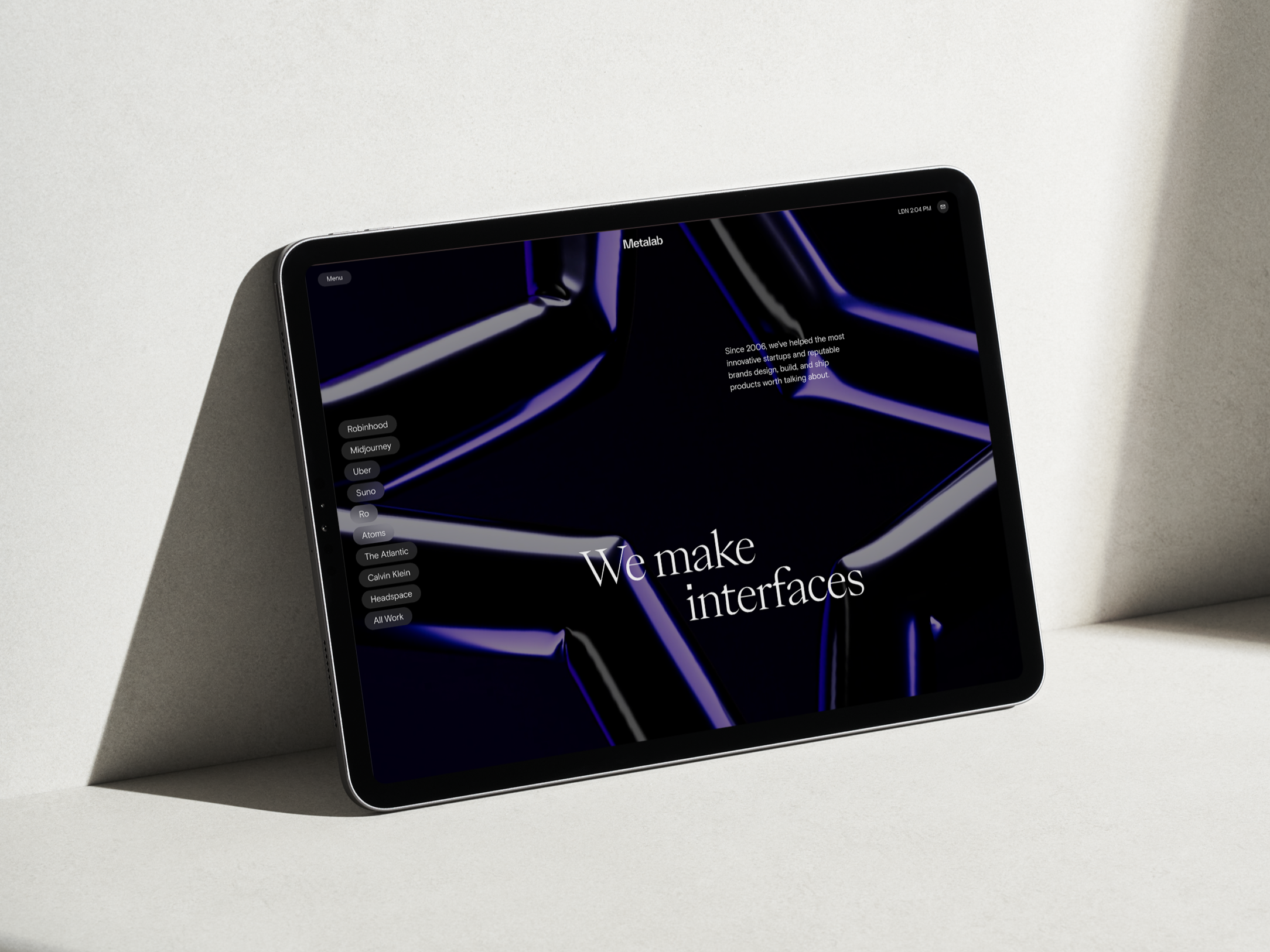
SaaS companies have a particular branding problem. The product is intangible, competitors can replicate features quickly and buyers are often presented with dozens of platforms making remarkably similar promises around speed, simplicity, automation and productivity.
A strong SaaS brand therefore has to do more than make software look good. It needs to explain why the product exists, establish a clear position in a crowded category and create a consistent experience across the website, sales process, product interface, onboarding, content and customer communications.
About That Brand has reviewed leading agencies working across B2B SaaS, enterprise software, product-led growth, AI software, developer tools and cloud platforms to identify the branding partners we believe offer the strongest combination of SaaS experience, strategic thinking, creative quality and digital capability in 2026.
• Last reviewed: August 2026
• 10 agencies selected
Areas considered: B2B SaaS, enterprise software, product-led SaaS, AI software, developer tools and cloud platforms
[Explore our full ranking methodology]
[See our wider ranking of the Best Branding Agencies for Technology Companies]
What are the best SaaS branding agencies in 2026?
Our leading SaaS branding agencies for 2026 are Focus Lab, Ramotion, Clay, Phable, MetaLab, The Branx, Koto, COLLINS, Ragged Edge and Siegel+Gale.
The right choice depends heavily on the stage of the software company and the problem behind the brief. Focus Lab is particularly strong for established B2B software companies requiring strategy, positioning and a comprehensive rebrand. Ramotion combines specialist SaaS branding with product and web expertise, while Clay is strongest where brand, website and digital-product experience need to work together.
Phable is particularly relevant to technically complex B2B SaaS businesses that need to communicate their proposition more clearly. MetaLab brings unusually deep product-led experience, The Branx focuses specifically on AI and SaaS startups, and Koto is a strong option for larger software businesses looking to build a more expansive international brand.
The best SaaS branding agencies at a glance
| Rank | Agency | Best for | Most suitable stage | Core strengths |
|---|---|---|---|---|
| 1 | Focus Lab | B2B SaaS companies ready for a serious rebrand | Startup to enterprise | Positioning, verbal identity, visual identity, web |
| 2 | Ramotion | Brand, website and product working as one system | Startup to scaleup | SaaS branding, UX/UI, web, design systems |
| 3 | Clay | Product-led SaaS and enterprise software | Startup to enterprise | Brand, product design, UX/UI, digital experience |
| 4 | Phable | Complex B2B SaaS that needs greater clarity | Startup to scaleup | Positioning, messaging, identity, web, content |
| 5 | MetaLab | Product-led software companies | Startup to scaleup | Brand, product strategy, UX/UI, digital products |
| 6 | The Branx | Early-stage SaaS startups | Pre-seed to Series B | Strategy, identity, web design, startup branding |
| 7 | Koto | SaaS brands with international ambitions | Scaleup to enterprise | Strategy, identity, motion, digital brand systems |
| 8 | COLLINS | Category-defining software businesses | Scaleup to enterprise | Positioning, narrative, identity, category strategy |
| 9 | Ragged Edge | SaaS challengers that need to stand apart | Scaleup | Positioning, verbal identity, visual identity, campaigns |
| 10 | Siegel+Gale | Complex enterprise software organisations | Enterprise | Brand strategy, architecture, simplification, identity |
The Top 10 SaaS Branding Agencies this year
1. Focus Lab
Best for: B2B SaaS companies ready for substantial strategic change
Ideal stage: Growth company to enterprise
Core strengths: Brand strategy, positioning, verbal identity, visual identity and web design
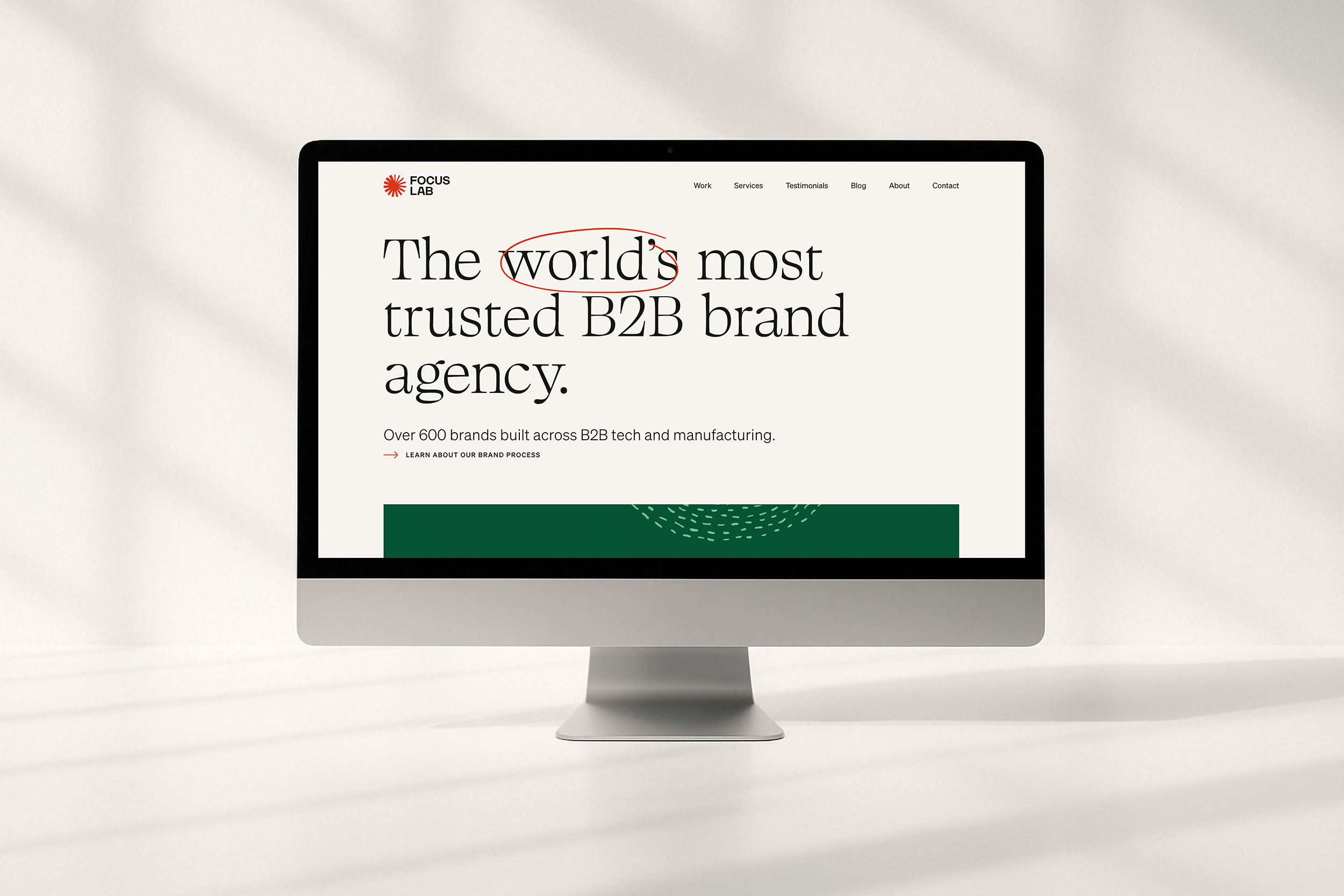
Focus Lab takes the top position because its experience is unusually concentrated around the problems facing B2B technology and software companies. The agency describes itself as a specialist B2B brand agency and has built brands across hundreds of B2B organisations, with a portfolio that includes software companies such as Salesloft, Totango, Contentstack, LaunchDarkly, Zuora and Merge.
Its strongest work tends to happen when a successful product has outgrown the brand around it. Focus Lab's work with Merge, for example, addressed a familiar SaaS problem: the company had established leadership in unified APIs, but its visual and verbal identity no longer communicated the maturity or breadth of the platform as it began targeting larger enterprise customers.
The agency works across positioning, verbal identity, visual identity and digital experience rather than treating branding primarily as an identity exercise. This makes it particularly relevant to SaaS businesses entering a new growth phase, moving upmarket, preparing for investment or trying to establish stronger category leadership.
Focus Lab also publishes unusually transparent pricing, with its core branding programme currently starting at $15,000 per month and larger structural rebrands starting at $25,000 per month.
Who should shortlist Focus Lab? B2B SaaS companies with an established product that need their positioning, messaging, visual identity and website to mature together.
2. Ramotion
Best for: SaaS companies that want brand, website and product design to work together
Ideal stage: Startup to scaleup
Core strengths: Brand strategy, visual identity, SaaS UX, web design and product design
Ramotion is one of the clearest SaaS specialists in this ranking. It operates a dedicated SaaS branding practice and publishes extensive software work across companies including Descript, Salesforce, Redis, Cypress, Stripe, Flatfile, Okta, Citrix, Clearbit and Xero.
Its particular strength is the ability to carry a brand beyond the marketing layer. SaaS customers experience a company through the homepage, demo, interface, onboarding, notifications, documentation and support. When each of those touchpoints feels as though it belongs to a different organisation, the brand quickly loses coherence.
Ramotion combines conventional branding services such as positioning, verbal identity, identity systems and guidelines with SaaS web design and UX. Its work for business automation platform Ninox, for example, is presented alongside improvements in retention and trial-to-paid conversion, while its Descript work connected brand identity with the website and wider product ecosystem.
The agency is therefore particularly relevant to product-led companies where the software itself is a major expression of the brand.
Who should shortlist Ramotion? B2B SaaS, developer tools, AI software, cybersecurity platforms and product-led software companies.
3. Clay
Best for: SaaS businesses where product experience is central to the brand
Ideal stage: Startup to enterprise
Core strengths: Branding, product design, UX/UI, websites and design systems
Clay began with a strong focus on digital-product and UX design and has developed into a broader creative agency combining strategy, branding, technology and digital experience. The agency specifically identifies SaaS software as one of the areas in which it has built its experience and describes preparing SaaS startups for enterprise customers as a common type of engagement.
That makes Clay particularly valuable to SaaS companies where the distinction between brand and product is becoming increasingly artificial.
Its work for HR technology platform Phenom involved creating a distinctive SaaS marketing experience, scalable design system, custom iconography and digital storytelling around a complex product portfolio. For enterprise HR software company Cornerstone, Clay worked across visual identity, UI/UX, design systems, illustration and motion to make a broad software offer easier to navigate and understand.
Clay is less of a pure brand-strategy consultancy than some agencies on this list. Its advantage is precisely the opposite: it is particularly strong when branding needs to become something customers can actually experience digitally.
Who should shortlist Clay? Product-led SaaS companies, enterprise software platforms and businesses planning a brand, website and product redesign together.
4. Phable
Best for: Technically complex B2B SaaS companies that need a clearer proposition
Ideal stage: Startup to scaleup
Core strengths: Positioning, messaging, visual identity, websites and content
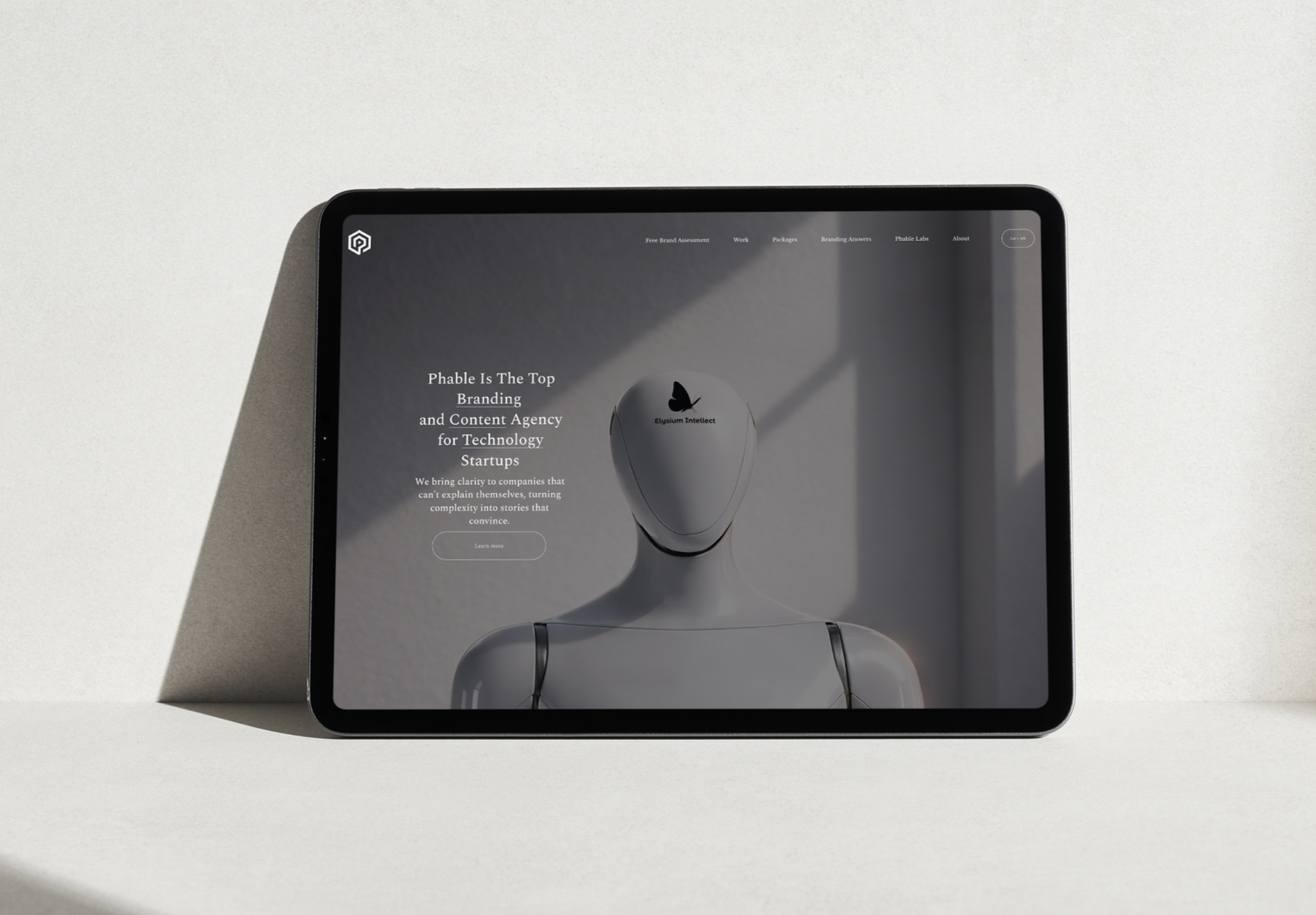
Phable specialises in branding and communications for technology businesses, with SaaS sitting alongside AI, DevOps, infrastructure, cloud, cybersecurity, fintech and data among its core areas of experience. Its stated approach is to understand the technology first before translating it into clearer positioning, messaging and creative communication.
This is particularly relevant to B2B SaaS companies. A software business can have an excellent product and still struggle commercially because prospective customers cannot quickly understand what it does differently. The problem is frequently amplified as founders and technical teams attempt to communicate years of product development through increasingly complicated feature lists.
Phable's work includes AI testing platform Appsurify and software-testing platform Virtuoso, where technically complicated products needed to remain credible to specialist users while becoming easier to understand and more distinctive within crowded SaaS categories.
Unlike a pure product-design agency, Phable also carries the brand into content and ongoing communication. This can make it particularly relevant to B2B SaaS companies where thought leadership, search visibility, founder communication and sales content sit alongside the core identity.
Who should shortlist Phable? Complex B2B SaaS companies, AI software businesses, developer tools and technical platforms where explaining the product is part of the branding challenge.
5. MetaLab
Best for: Product-led SaaS companies
Ideal stage: Funded startup to scaleup
Core strengths: Product strategy, product design, UX/UI, brand and digital experience
MetaLab deserves its place because few studios have a stronger pedigree in designing software products that subsequently become major brands.
Slack is the clearest example. MetaLab worked with the company in its early stages, helping to develop the original product suite and brand as Slack set out to become a new standard for workplace communication. The studio's current portfolio continues to span SaaS, AI, productivity software, developer platforms and other digital products.
Its approach is particularly relevant to product-led growth. In PLG businesses, customers may encounter the software before ever speaking to sales. Product usability, interface design, onboarding and brand perception therefore become parts of the same customer experience.
MetaLab is not the natural choice for a business that simply needs a new logo or a standalone marketing website. Its value increases when the product itself needs strategic and creative attention alongside the brand.
Who should shortlist MetaLab? Product-led SaaS companies, collaboration platforms, AI software and funded startups where the interface is central to customer acquisition and retention.
6. The Branx
Best for: Early-stage SaaS startups
Ideal stage: Pre-seed to Series B
Core strengths: Brand strategy, visual identity, web design and startup launch systems
The Branx is one of the more specialised agencies in this ranking. It explicitly positions itself as a branding agency for AI and SaaS startups and has developed more than 120 technology startup brands across the US, Canada, UK and Europe. Its portfolio can be filtered specifically for B2B SaaS businesses.
That makes it particularly relevant to founders creating their first serious brand rather than replacing an established one.
Early-stage SaaS companies rarely need the organisational complexity of a global consultancy. They typically need a clear proposition, a credible identity, a website capable of explaining the product and a visual system that will not immediately fall apart when the marketing team begins creating new material.
The Branx's process combines strategy, visual identity, illustration and motion with website design and development, giving early-stage companies a relatively complete launch system.
Its narrower startup focus may make it less appropriate for a large enterprise software company with complex global architecture or stakeholder requirements.
Who should shortlist The Branx? Seed and Series A SaaS startups, particularly companies preparing to launch, raise investment or replace an early founder-created identity.
7. Koto
Best for: SaaS companies becoming major international brands
Ideal stage: Scaleup to enterprise
Core strengths: Strategy, brand systems, digital experience, motion and campaigns
Koto brings a different scale and creative ambition to SaaS branding. Its technology and software work includes brands such as Workday, Stack Overflow, Coda and Microsoft, alongside wider digital and technology platforms.
Its work for Workday is particularly relevant to enterprise SaaS. The project refreshed the identity of the global HR and finance software company while retaining the credibility required by enterprise buyers, developing a warmer and more expressive system that could function across technical documentation, employee interfaces and wider communications.
Koto is consequently strongest when a SaaS company has moved beyond simply needing to explain what the product does. The business may already have significant recognition but needs to create a richer emotional and creative identity around that functionality.
For a pre-seed B2B platform still resolving its proposition, this level of brand programme may be unnecessary. For a successful SaaS company entering new markets or trying to establish itself as a globally recognisable brand, Koto becomes considerably more compelling.
Who should shortlist Koto? Established software scaleups, enterprise SaaS companies and digital platforms with international ambitions.
8. COLLINS
Best for: SaaS companies trying to define or expand a category
Ideal stage: Scaleup to enterprise
Core strengths: Positioning, category strategy, brand narrative and identity
COLLINS is particularly interesting for software companies whose branding problem is connected to how the market categorises the product.
Its work with Figma provides one of the clearest examples. Rather than positioning the platform solely as a tool for designers, COLLINS helped develop a wider story around collaboration, effectively broadening the perceived audience from designers towards the much larger product-development community. COLLINS reports that the work expanded the perceived addressable market from 10 million designers to 68 million collaborators across the product-development value chain.
That is a different kind of branding challenge from simply refreshing a visual identity. Successful SaaS businesses can eventually become constrained by the category that initially helped people understand them. Repositioning can then create room for new products, audiences or commercial opportunities.
COLLINS is most compelling when the ambition is therefore strategic as well as creative.
Who should shortlist COLLINS? Established SaaS platforms, collaborative software businesses and scaleups attempting to redefine or expand their category.
9. Ragged Edge
Best for: SaaS challengers operating in visually crowded categories
Ideal stage: Scaleup
Core strengths: Positioning, verbal identity, visual identity and campaigns
Ragged Edge is particularly good at making technology brands feel unlike the category around them.
Its recent work for AI software company Granola demonstrates that strength particularly clearly. Rather than adopting the polished, futuristic visual language common across AI productivity software, Ragged Edge built a warmer, deliberately human identity around the realities of creative work. The agency reports that Granola became the second-fastest-growing software brand in Ramp's data in the month following launch and subsequently reached a $1.5 billion valuation following a $125 million investment.
Its previous work with HR, payroll and insurance platform Bayzat similarly moved the business beyond product features towards a broader proposition around improving working life.
Ragged Edge is therefore particularly compelling when a SaaS company has reached the point where competent branding is no longer enough. The business needs to become recognisably different.
Who should shortlist Ragged Edge? SaaS challengers, AI productivity products and software brands seeking a much more distinctive market position.
10. Siegel+Gale
Best for: Enterprise SaaS and software businesses with complex portfolios
Ideal stage: Enterprise
Core strengths: Brand strategy, architecture, simplification, naming and identity
Siegel+Gale's core philosophy is built around simplicity, which has obvious relevance to enterprise software.
Its technology practice includes work across software, cloud and enterprise technology, while its long relationship with SAP has involved helping the organisation manage an expanding portfolio as it moved from traditional back-office software towards cloud-based end-to-end solutions.
At this level, the branding challenge is rarely limited to creating a more attractive identity. Enterprise software businesses accumulate products, acquisitions, sub-brands and specialist terminology over many years. Customers can eventually struggle to understand how the different parts fit together.
Siegel+Gale is particularly useful when simplification and brand architecture need to sit alongside positioning and design.
The scale of its work makes it less likely to be appropriate for an early-stage SaaS startup, but highly relevant to established software companies navigating large portfolios or major organisational change.
Who should shortlist Siegel+Gale? Global enterprise software companies, cloud platforms and mature SaaS organisations with complicated product portfolios.
What is a SaaS Branding Agency?
A SaaS branding agency specialises in developing brands for software-as-a-service businesses. Its work can include positioning, proposition development, messaging, naming, verbal identity, visual identity, websites, product interfaces, design systems and the wider communication required to take a software product to market.
SaaS branding differs from conventional product branding because there is usually no physical product to communicate. Customers experience the brand through digital touchpoints, beginning with search results, advertising or the company website and continuing into demos, free trials, onboarding, software interfaces, support and renewal.
A specialist agency therefore needs to understand not simply how to create an identity, but how that identity operates within the commercial mechanics of a subscription software business.
Why is SaaS Branding Different?
The product is intangible
A software company cannot rely on packaging, stores or a physical product to create recognition. Its website, interface, language and customer experience become the packaging.
This makes clarity particularly important. Prospective customers should be able to understand what the software does, who it is for and why it is different without decoding a complicated list of features.
SaaS categories become crowded quickly
Successful software ideas attract competitors. Features that once created meaningful differentiation can become expected functionality within a relatively short period.
Brand can therefore create distinction that is harder to reproduce than an individual feature.
Buyers and users may be different people
In B2B SaaS, the person using the product may not be the person purchasing it.
A developer might evaluate technical capability, a department head may care about team performance, procurement may examine risk and price, and senior leadership may be focused on financial return. Good SaaS positioning has to work across these different levels of understanding.
The brand lives inside the product
The relationship does not end once someone buys the software. Subscription businesses depend on continued usage and renewal.
The experience after acquisition therefore matters enormously. The strongest SaaS brands maintain a recognisable character across onboarding, interface design, notifications, documentation and customer communication rather than disappearing once somebody logs in.
Best SaaS Branding Agencies by Need
Best branding agency for B2B SaaS
For B2B SaaS, Focus Lab, Phable and Ramotion are particularly strong choices.
Focus Lab has substantial evidence across established B2B software brands and is particularly appropriate for companies approaching a major growth or repositioning moment. Phable is a strong option when the software itself is technically difficult to explain, while Ramotion becomes particularly valuable when brand, website and product experience need to be developed together.
Best branding agency for an early-stage SaaS startup
The Branx, Phable and Ramotion are particularly relevant to early-stage companies.
The Branx focuses specifically on AI and SaaS startups, while Phable is useful for founder-led companies where positioning and messaging are still evolving alongside the product. Ramotion offers a stronger product-design component where UX and UI form part of the project.
Startups should generally prioritise clarity and flexibility over the complexity of a large corporate branding programme.
Best branding agency for a SaaS scaleup
For a SaaS company that already has product-market fit, Focus Lab, Koto, COLLINS and Ragged Edge become particularly interesting.
At this stage the challenge is often no longer proving that the product works. Instead, the company needs to establish stronger category leadership, move into larger accounts, support new products or create a brand capable of competing internationally.
Best agency for SaaS brand and product design
MetaLab, Clay and Ramotion stand out where product design is an important part of the brief.
All three have significant experience working inside software rather than limiting their role to the external brand. This is particularly valuable for product-led SaaS companies where the interface itself is one of the most important customer touchpoints.
Best agency for enterprise SaaS
Siegel+Gale, Koto and Focus Lab are particularly appropriate for larger SaaS organisations.
Siegel+Gale is strongest where architecture and organisational complexity need to be simplified. Koto offers strong creative and digital systems for internationally recognised software brands, while Focus Lab sits particularly well between specialist B2B expertise and larger-scale rebranding requirements.
How Much Does SaaS Branding Cost?
There is no standard price for branding a SaaS company because the scope of the work varies considerably.
A seed-stage company commissioning positioning, messaging and its first professional visual identity is buying a very different service from a Series C business replacing an established brand, redesigning its website and migrating a large library of marketing assets.
Specialist SaaS branding projects will commonly move into five-figure budgets once meaningful strategy and identity work are involved. Larger programmes combining research, positioning, messaging, identity, web design and product experience can reach six figures, while major enterprise software transformations can cost considerably more.
Some agencies publish pricing. Focus Lab, for example, currently lists its focused branding programme from $15,000 per month, generally lasting between one and three months, while larger structural rebrands begin at $25,000 per month.
Companies should therefore compare scope rather than headline price. A £25,000 identity project and a £100,000 programme encompassing research, positioning, verbal identity, visual identity and a website are not expensive and inexpensive versions of the same product.
How to Choose a SaaS Branding Agency
Begin by identifying what is actually wrong.
If customers consistently struggle to understand the product, the priority is likely to be positioning and messaging. If the proposition is strong but the company looks considerably smaller or less sophisticated than it has become, the identity may be the greater issue. If the marketing website and software feel like different companies, product and digital design capability should carry more weight.
Look closely at agency case studies rather than client logos. Establish what the agency actually delivered, whether it developed the strategy or merely executed an identity, and whether the work involved a business at a similar stage to yours.
It is also important to understand whether the agency has experience with the way your SaaS business sells. Product-led software, enterprise SaaS and founder-led B2B platforms have very different customer journeys.
The best SaaS branding agency is therefore not necessarily the agency with the most famous software company in its portfolio. It is the one whose expertise most closely matches the commercial problem your business needs to solve.
How About That Brand Ranks SaaS Branding Agencies
Agencies in this guide are assessed using About That Brand's established independent ranking methodology.
For this SaaS category, particular consideration is given to evidence of software and SaaS work, strategic positioning capability, the quality of identity systems, understanding of digital products, ability to communicate complex propositions and suitability for different stages of software-company growth.
A large international consultancy and a specialist startup agency are not necessarily competing for the same brief. Rankings therefore consider fit as well as reputation, with the aim of helping companies understand where individual agencies are strongest.
Frequently Asked Questions About SaaS Branding Agencies
-
About That Brand ranks Focus Lab as the leading SaaS branding agency in 2026 because of its depth of B2B technology experience, strategic capability and substantial portfolio of software companies. Ramotion is particularly strong for projects connecting brand with product design, Clay for SaaS digital experience and Phable for technically complex B2B SaaS.
-
A SaaS branding agency helps software companies establish how they should be understood, positioned and recognised. Services can include research, positioning, messaging, naming, verbal identity, visual identity, web design, product design, brand architecture and design systems.
-
Focus Lab, Phable and Ramotion are among the strongest choices for B2B SaaS. Focus Lab is particularly suited to established B2B software businesses, Phable to complex products requiring clearer positioning and messaging, and Ramotion to brands that also require substantial web or product-design expertise.
-
The Branx, Phable and Ramotion are particularly suitable for SaaS startups. The Branx specialises specifically in startup branding, Phable focuses on technically complex emerging technology and Ramotion combines branding with software-product expertise.
-
A substantial SaaS branding project will generally require a five-figure budget, with comprehensive scaleup rebrands frequently moving into six figures once research, strategy, messaging, visual identity and website design are included. Large enterprise software branding programmes can cost considerably more.
-
Common triggers include moving upmarket, targeting enterprise customers, raising a significant investment round, entering new markets, expanding the product portfolio or discovering that customers consistently misunderstand the proposition. Another common trigger occurs when the product and company have matured but the brand still makes the business appear early-stage.
-
Common triggers include moving into a new market, raising significant investment, moving from startup to scaleup, targeting enterprise customers, introducing new products, completing acquisitions or reaching a point where the company's existing story no longer accurately describes the business. Persistent confusion about what the company does can itself be a strong indication that positioning and branding need attention.
-
Not necessarily, but the brand should be capable of working inside the product. For product-led SaaS companies in particular, the interface is a major brand touchpoint. Agencies such as MetaLab, Clay and Ramotion are particularly relevant where brand and product experience need to be considered together.
-
Yes. Branding defines how the company is positioned, recognised and understood, while marketing is concerned with taking that proposition to market and generating demand. The two should work together, but a campaign cannot compensate indefinitely for unclear positioning or an undifferentiated brand.
About This Ranking
Last researched: August 2026
Ranking: Best SaaS Branding Agencies in 2026
Reviewed categories: B2B SaaS, enterprise software, product-led SaaS, AI software, developer tools and cloud platforms
Review approach: Editorial assessment using the About That Brand agency ranking methodology
About That Brand periodically reviews its rankings as agency portfolios, teams, specialist expertise and the wider branding industry change.
[View our ranking methodology]
[Explore the Best Branding Agencies for Technology Companies]