
Best Fintech Branding Agencies in 2026

Fintech companies have to solve an unusual branding challenge. They need to look progressive enough to challenge established financial institutions while appearing credible enough for customers, investors and enterprise buyers to trust them with money, financial data and important decisions.
That balance is becoming harder to achieve. Payments, digital banking, lending, wealthtech, embedded finance, financial infrastructure and digital assets are increasingly crowded with businesses making similar promises around speed, security, transparency and simplicity.
The best fintech branding agencies understand that trust and differentiation have to work together. They can simplify complicated financial products, establish a clear position in the market and create brands capable of working across websites, applications, product interfaces, sales communications and regulated environments.
About That Brand has reviewed branding agencies working across financial technology to identify the firms we believe offer the strongest combination of fintech experience, strategic thinking, creative quality and suitability for different types of financial technology business in 2026.
Last reviewed: August 2026
10 agencies selected
Areas considered: payments, digital banking, lending, embedded finance, wealthtech, regtech, financial infrastructure, digital assets and B2B fintech
[Explore our full ranking methodology]
[Explore the Best Branding Agencies for Technology Companies]
What are the best fintech branding agencies in 2026?
Our leading fintech branding agencies for 2026 are Ragged Edge, Together, Fintech Branding Studio, CSTMR, Phable, Block Club, Emotive Brand, Hangar, Pentagram and Nucleus.
There is no single best agency for every fintech company.
Ragged Edge takes the top position for its work creating some of the most distinctive financial technology brands in the market, including Wise and Monzo. Together is particularly strong for B2B fintech, payments infrastructure and financial platforms, while Fintech Branding Studio offers unusually concentrated category expertise across digital banking, brokerage, payments, crypto and financial infrastructure.
CSTMR combines fintech branding with marketing and growth capability. Phable is particularly relevant to technically complex fintech startups, while Block Club brings deep experience across B2B financial infrastructure brands including Plaid, Alloy, Argyle, Codat and Middesk.
The best fintech branding agencies at a glance
| Rank | Agency | Best for | Most suitable stage | Fintech strengths |
|---|---|---|---|---|
| 1 | Ragged Edge | Distinctive fintech challenger brands | Scaleup | Payments, banking, consumer finance, insurance |
| 2 | Together | B2B fintech and financial infrastructure | Startup to scaleup | Payments, embedded finance, financial data, fintech platforms |
| 3 | Fintech Branding Studio | Specialist fintech branding | Startup to scaleup | Digital banking, brokerage, crypto, payments, DeFi |
| 4 | CSTMR | Fintech branding combined with growth marketing | Startup to enterprise | Banking, lending, payments, wealthtech, insurance |
| 5 | Phable | Complex fintech products that need greater clarity | Startup to scaleup | Payments, digital assets, financial infrastructure, emerging fintech |
| 6 | Block Club | B2B fintech positioning and content | Series A onwards | Payments infrastructure, banking data, identity, regtech |
| 7 | Emotive Brand | Strategic fintech positioning and category differentiation | Scaleup | Payments, B2B fintech, financial platforms |
| 8 | Hangar | Emerging fintech and payments businesses | Startup to scaleup | Payments infrastructure, fintech positioning, digital |
| 9 | Pentagram | High-profile fintech identity and design | Scaleup to enterprise | Payments, banking, regtech, digital assets |
| 10 | Nucleus | Financial services and digital banking | Scaleup to enterprise | Digital banking, payments, wealthtech, financial services |
The Top 10 Fintech Branding Agencies
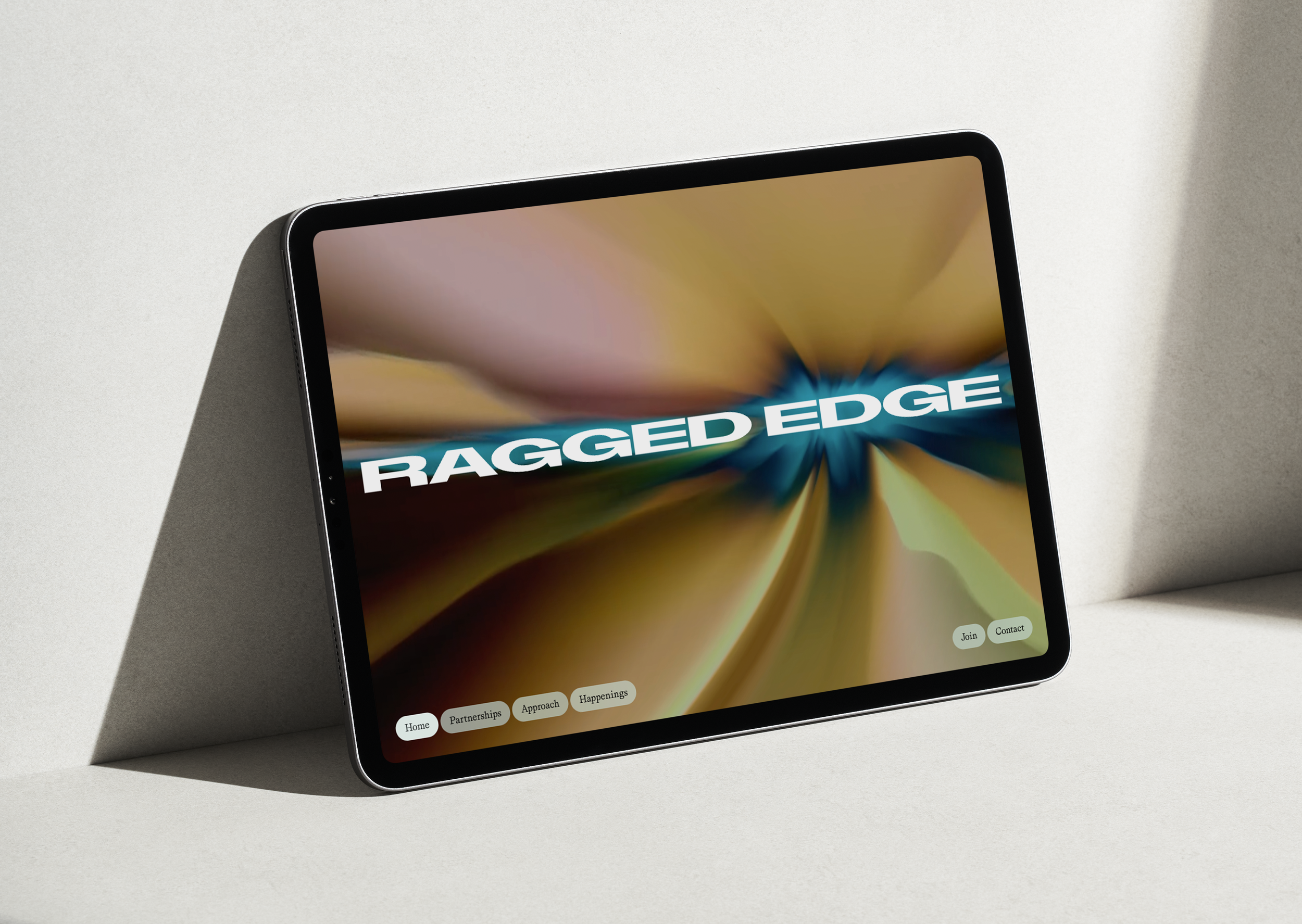
1. Ragged Edge
Best for: Fintech challengers that need to build a genuinely distinctive market position
Ideal stage: Scaleup
Core strengths: Positioning, verbal identity, visual identity, brand systems and campaigns
Ragged Edge takes the top position because fintech is responsible for some of the agency's most convincing and commercially significant work.
Its relationship with Wise is particularly notable. Ragged Edge developed a global rebrand designed to take the company beyond its origins in international money transfer and establish a much broader proposition around "the world's money". The identity was rolled out across 175 countries and created a brand capable of working across both consumer and business audiences.
The agency has also worked extensively with Monzo, evolving the digital bank's identity as the company expanded across products and moved towards profitability. The resulting system was designed to operate consistently inside and outside the product while retaining the recognisable character the bank had already established.
Ragged Edge's particular advantage is its willingness to move away from the restrained, corporate visual language traditionally associated with financial trust. Rather than making fintech challengers resemble established banks, its strongest work identifies what makes them fundamentally different.
That makes Ragged Edge especially compelling when emotional distinction and consumer recognition matter alongside product functionality.
Who should shortlist Ragged Edge? Digital banks, payments businesses, insurtechs, consumer finance platforms and fintech scaleups looking to establish a stronger challenger position.
2. Together
Best for: B2B fintech, payments and financial infrastructure
Ideal stage: Startup to scaleup
Core strengths: Positioning, messaging, identity, websites and technical product storytelling
Together has built a particularly strong body of current work across B2B financial technology.
Its fintech portfolio includes businesses operating across payment intelligence, embedded payments, financial infrastructure and finance software. Recent projects include Spade, Aria, Unit, Tabs and Trullion.
Its work for transaction-intelligence platform Spade is a strong example of why Together ranks highly. The product sits behind banks and fintech platforms, making the underlying technology both technically complicated and largely invisible to the end customer. Together developed a clearer narrative connecting Spade's data infrastructure with commercial outcomes, then translated that positioning into a scalable identity and website built for technical teams and enterprise buyers.
This ability to move between technical understanding and commercial communication is particularly valuable in B2B fintech, where a brand may need to convince engineers, product teams, procurement and senior decision-makers during the same buying process.
Together is therefore especially strong for businesses building the infrastructure behind modern financial services rather than purely consumer-facing products.
Who should shortlist Together? Payments infrastructure, embedded-finance platforms, financial APIs, banking technology, accounting platforms and B2B fintech companies selling to enterprise customers.
3. Fintech Branding Studio
Best for: Fintech companies looking for a genuinely specialist branding partner
Ideal stage: Startup to scaleup
Core strengths: Brand discovery, positioning, visual identity, digital design and fintech specialisation
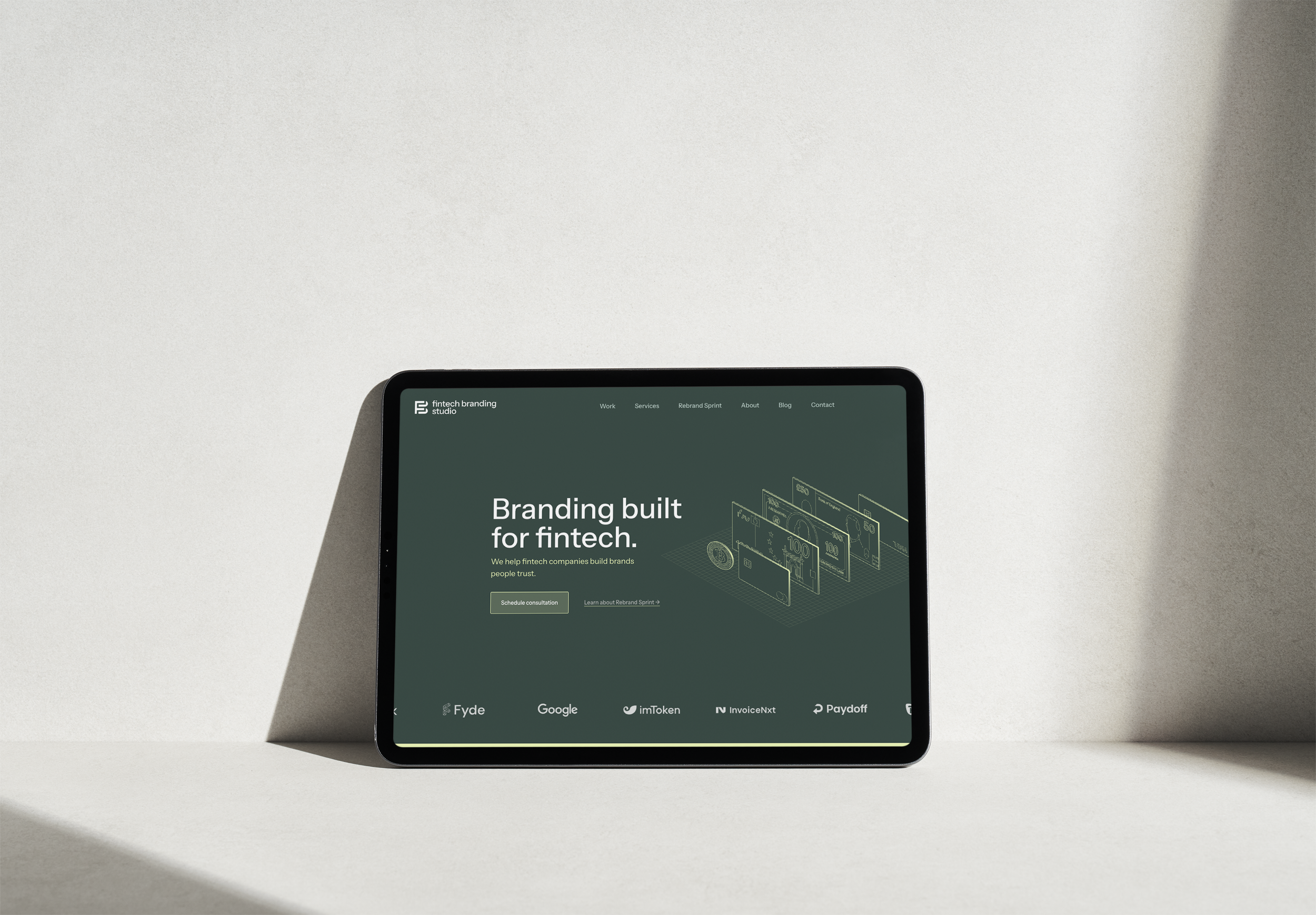
Fintech Branding Studio earns a high position because its entire proposition is built around the financial technology category rather than fintech being one sector among many.
Its published portfolio spans multi-asset brokerage, crypto payments, digital banking, risk intelligence, DeFi, liquidity and supply-chain finance. Clients include BlackBull, Pepperstone, Triple-A, Flowdesk, Thomas Murray, Zero, Fyde and InvoiceNxt.
That breadth gives the studio familiarity with one of the central challenges in fintech branding: different financial products require very different forms of credibility.
A retail brokerage needs to establish confidence with consumers. A cryptocurrency payments platform may need to make unfamiliar technology feel more legitimate. A risk-intelligence company needs to demonstrate expertise to sophisticated financial organisations. A digital bank has to combine accessibility with trust.
Fintech Branding Studio is particularly useful for companies that value specialist category knowledge but do not require the size or organisational complexity of a major international consultancy.
Who should shortlist Fintech Branding Studio? Fintech startups and scaleups in payments, digital banking, brokerage, digital assets, financial infrastructure and DeFi.
4. CSTMR
Best for: Fintech companies that need branding and growth marketing to work together
Ideal stage: Startup to enterprise
Core strengths: Brand strategy, positioning, identity, digital experience, SEO and marketing
CSTMR differs from many of the agencies in this ranking because branding sits within a much broader fintech and financial-services marketing practice.
Its experience spans banking, lending, payments, insurance, SaaS and financial technology, with published work for businesses including nCino, ValidMind, Bankuity, Pursuit, AccessOne, Nexi, UniTeller and the American Bankers Association.
This breadth makes CSTMR particularly useful when creating the brand is only the beginning of the requirement.
Its services extend from market and audience analysis, brand strategy and visual identity into websites, content, search visibility, paid acquisition and ongoing marketing. The agency consequently offers a different proposition from a studio focused primarily on a rebrand and handover.
That can be particularly valuable to growth-stage fintech companies with small internal marketing teams, where positioning, website performance, search visibility and customer acquisition need to develop together.
Who should shortlist CSTMR? Lending platforms, banking technology, fintech scaleups, payments businesses and financial-services companies looking for an ongoing branding and marketing partner.
5. Phable
Best for: Technically complex fintech companies that need to become easier to understand
Ideal stage: Startup to scaleup
Core strengths: Positioning, messaging, visual identity, websites and content
Phable approaches fintech from the wider world of technically complex technology.
That makes the agency particularly relevant when the branding challenge begins with understanding the product itself. Emerging financial technology can involve infrastructure, APIs, cryptocurrency, novel payment mechanisms or products that do not fit comfortably into familiar financial categories. Before those businesses can become more distinctive, they often need to become easier to explain.
Phable's fintech experience includes ViaCash, which built one of Europe's largest bank-independent payment infrastructures. The company connects banks, retailers and consumers to allow cash deposits and withdrawals at retail checkouts. Phable redesigned its digital presence around making this unusual system easier to understand, before supporting the business with thought-leadership content around payments, accessibility and financial inclusion.
The agency has also worked with EvoMone, a fintech product combining a self-custody Bitcoin wallet with private messaging. Phable developed the brand, identity and website around making technically complicated cryptocurrency functionality feel significantly more straightforward and accessible.
This combination of product understanding, positioning and ongoing communication makes Phable particularly relevant to founder-led fintech businesses operating at the more technical edge of the category.
Who should shortlist Phable? Payments companies, financial infrastructure, digital-asset platforms, crypto products and technically complex B2B fintech startups.
6. Block Club
Best for: B2B fintech positioning, messaging and content
Ideal stage: Series A onwards
Core strengths: Brand strategy, messaging, visual identity, content and category development
Block Club has one of the deepest B2B fintech client lists in this ranking.
Its work includes Plaid, Alloy, Argyle, Codat, Middesk, Lithic and other companies operating across payments, identity verification, financial data, lending and banking infrastructure.
Its strength lies particularly in what happens after the initial brand strategy.
B2B fintech companies often sell through long buying cycles in which expertise, proof and perceived risk are critical. Block Club connects positioning and identity with thought leadership, customer stories, sales enablement and ongoing content designed to reinforce the brand throughout that buying process.
Its work with Codat illustrates the strategic side of the practice. As the product moved beyond its original "universal API" category towards a broader proposition for commercial banking, Block Club developed a narrative capable of serving both the established business and the company's new growth audience.
This makes Block Club particularly relevant to scaleups where the brand needs to contribute directly to demand generation and enterprise sales.
Who should shortlist Block Club? B2B payments, banking infrastructure, identity verification, financial-data platforms, regtech and Series A or later fintech companies.
7. Emotive Brand
Best for: Fintech businesses facing a significant positioning challenge
Ideal stage: Scaleup
Core strengths: Research, positioning, leadership alignment, brand strategy and visual identity
Emotive Brand earns its place through strong strategic work in complex B2B markets, including a significant engagement with payments technology business Marqeta.
Marqeta occupied a difficult position between disruptive technology startups and established global financial-services organisations. The challenge was not simply to update how the company looked, but to establish a distinctive position within a crowded and technically complex payments ecosystem.
Emotive Brand used research, interviews, workshops and strategic development to define a position around payment innovation before translating that thinking into messaging and visual identity.
The case study is particularly relevant because it demonstrates an understanding of a common B2B fintech challenge: one brand may need to appeal simultaneously to innovative technology teams and conservative financial institutions.
Emotive Brand is therefore strongest where strategic clarity and leadership alignment need to precede the creative work.
Who should shortlist Emotive Brand? Payments businesses, B2B financial platforms and fintech scaleups whose current positioning no longer reflects their market opportunity.
8. Hangar
Best for: Fintech startups that want a focused, distinctive brand
Ideal stage: Startup to scaleup
Core strengths: Positioning, messaging, branding, web design and development
Hangar offers a more boutique option for emerging fintech companies.
Its work for Paytrix demonstrates a particularly relevant understanding of financial infrastructure. Paytrix was created to simplify the complexity faced by merchants scaling payments across multiple markets through a proposition based around one contract and one API.
Hangar worked across positioning, messaging, branding, web design and development, developing the idea of "Smooth Scaling Payments" and an identity deliberately designed to stand apart from the blues and greens prevalent across financial technology.
The resulting project is a useful example of fintech branding in which product proposition and visual differentiation were addressed together.
Hangar is particularly relevant to younger businesses that want close collaboration and a distinctive launch or growth-stage identity without requiring the organisational scale of a global agency.
Who should shortlist Hangar? Payment platforms, embedded-finance businesses and fintech startups requiring positioning, identity and a digital presence.
9. Pentagram
Best for: Major fintech brands where exceptional design is a strategic priority
Ideal stage: Scaleup to enterprise
Core strengths: Brand strategy, visual identity, verbal identity and digital design
Pentagram has one of the broadest and most prestigious fintech portfolios in the market.
Its work includes PayPal, Wirex, Payz, Tala and regulatory-technology platform Droit, spanning global payments, digital money, digital banking, financial inclusion and institutional fintech.
Its PayPal identity illustrates the scale at which Pentagram can operate. The work created a new visual strategic foundation, bespoke typeface and motion language for one of the world's best-known financial technology businesses, centred around simplicity, optimism and trust.
At the other end of the category, its work for Droit had to communicate highly sophisticated technology used to interpret financial regulation in real time for major institutional investors.
Pentagram ranks lower here than it does on our broader Technology list because most fintech companies will not require its scale or creative firepower. For ambitious, well-funded financial technology businesses where identity can become a major strategic asset, however, it remains an exceptional choice.
Who should shortlist Pentagram? Established fintechs, global payment businesses, digital banks, institutional technology platforms and well-funded scaleups.
10. Nucleus
Best for: Financial-services brands combining strategy with digital banking experience
Ideal stage: Scaleup to enterprise
Core strengths: Brand strategy, naming, digital experience, UX and financial-services branding
Nucleus brings unusually deep experience from the wider financial-services sector.
Its portfolio covers online banking, payments, wealth management, investment banking and fintech, with published work including TAJBank, Azqore, sQuid, Smart Transactions Group, Standard Chartered, HSBC and other financial organisations.
That heritage is useful because fintech increasingly overlaps with conventional financial services. Digital banks need to understand traditional banking expectations, while established banks increasingly launch products designed to compete directly with fintech challengers.
Nucleus also combines branding with digital and UX work, including online banking and financial applications. This makes it particularly relevant where the customer journey forms a significant part of the brief.
Its experience is broader than pure fintech, which is why more specialised studios rank above it. For financial businesses where technology, digital experience and institutional credibility intersect, it remains a strong option.
Who should shortlist Nucleus? Digital banks, payments companies, wealthtech businesses and established financial organisations launching or repositioning technology-led products.
What is a Fintech Branding Agency?
A fintech branding agency specialises in creating and developing brands for businesses operating at the intersection of finance and technology.
These businesses can include digital banks, payment platforms, embedded-finance providers, lenders, wealthtech companies, insurance technology, financial infrastructure, cryptocurrency and digital-asset platforms, identity and fraud systems, regtech and software used by banks or finance teams.
The work usually extends beyond logo design.
A fintech branding agency may help establish the company's position in the market, simplify its proposition, develop messaging, create a name and verbal identity, design the visual system and translate that brand into websites, applications, product interfaces, sales materials and ongoing communications.
The strongest agencies understand that trust cannot simply be designed into a logo. It emerges from the clarity of the proposition, consistency of the customer experience and whether the promises being made feel credible.
Why is Fintech Branding Different?
Trust is part of the product
Financial technology asks customers to take actions they naturally approach with caution.
Opening an account, connecting financial data, transferring money, investing savings or allowing software to make decisions about payments creates a considerably higher threshold for trust than signing up for most digital products.
The brand therefore has a direct role in reducing perceived risk.
Fintech needs innovation and credibility at the same time
Traditional banks often possess recognition and institutional trust but can struggle to appear innovative.
Fintech startups frequently face the opposite problem.
A brand that feels too much like an established financial institution can weaken the perception that something genuinely different has been created. A brand that feels excessively experimental can make customers question whether they should trust the company with money or sensitive information.
The strongest fintech brands occupy a position between those two extremes.
Financial technology can be difficult to explain
Some of the fastest-growing parts of fintech are largely invisible to consumers.
Payment orchestration, transaction enrichment, banking APIs, embedded finance, identity verification and regulatory technology often operate behind other financial products.
The branding challenge is therefore frequently one of translation.
A technically accurate explanation may mean little to a commercial buyer. An oversimplified explanation can undermine credibility with specialists. Strong fintech positioning needs to work at both levels.
Regulation affects communication
Financial businesses operate within environments where what a company says can matter legally as well as commercially.
Claims around returns, performance, lending, security and customer outcomes may need to pass through legal or compliance teams.
A fintech branding agency does not replace specialist regulatory advice, but it should be comfortable creating distinctive communications within those constraints and working alongside compliance stakeholders.
Best Fintech Branding Agencies by Specialism
Best branding agencies for payments companies
Together, Ragged Edge, Pentagram and Hangar are particularly strong choices for payments.
Together has deep experience in payment intelligence and infrastructure through businesses such as Spade. Ragged Edge has transformed Wise into one of the world's most distinctive financial brands. Pentagram brings extensive payments work through PayPal, Wirex and Payz, while Hangar offers a strong boutique option through its work with Paytrix.
Best branding agencies for B2B fintech
For B2B fintech, Together, Block Club and Phable are particularly compelling.
Together is strong where technical infrastructure needs translating into an enterprise proposition. Block Club combines deep financial-sector knowledge with positioning, content and sales enablement, while Phable is especially relevant when the underlying financial technology itself is difficult to explain.
Best branding agencies for fintech startups
For earlier-stage businesses, Fintech Branding Studio, Phable and Hangar offer particularly relevant propositions.
All three can operate comfortably with emerging businesses without requiring the scale of a large international consultancy.
Fintech Branding Studio offers deep category specialisation, Phable is strongest where the technology and proposition are complex, and Hangar provides a focused boutique option for fintech startups building their first serious market identity.
Best branding agencies for consumer fintech
Ragged Edge, Pentagram and Fintech Branding Studio stand out for consumer-facing financial technology.
Consumer fintech has to earn trust quickly while creating enough personality to become recognisable. Ragged Edge's Wise and Monzo work demonstrates how powerful that distinction can become, while Pentagram has extensive experience with consumer payment and banking platforms.
Best agencies for fintech brand and marketing
CSTMR, Block Club and Phable are particularly relevant when the requirement continues after the rebrand.
CSTMR combines branding with digital marketing, content and search. Block Club connects brand strategy to ongoing thought leadership and sales enablement. Phable combines branding with content and communication around technically complicated products.
This can be valuable to fintech businesses with relatively small internal marketing teams that require one partner to help both define and communicate the proposition.
Best agencies for complex financial technology
For products that are particularly difficult to explain, Phable, Together and Emotive Brand are strong options.
Their published work includes payment infrastructure, transaction intelligence, cryptocurrency, B2B payments and complex financial ecosystems where simplifying the proposition forms an important part of the engagement.
Best branding agencies for digital assets and crypto
Fintech Branding Studio, Pentagram and Phable have particularly relevant experience.
Fintech Branding Studio's portfolio includes crypto payments, liquidity and DeFi. Pentagram has worked with Wirex and other digital-finance businesses, while Phable's EvoMone project combines cryptocurrency functionality with a consumer-facing fintech proposition.
How Much Does Fintech Branding Cost?
There is no standard cost for fintech branding.
A newly funded startup commissioning positioning, messaging and its first professional identity requires a very different programme from an established payment platform undertaking research, brand architecture, identity, website redesign and international implementation.
Substantial specialist branding projects generally move into five-figure budgets once meaningful strategy and identity work are involved. Larger scaleup programmes combining research, positioning, messaging, identity and a new digital presence can move into six figures.
Enterprise financial-brand transformations can cost considerably more.
Some specialist agencies publish indicative figures. Block Club currently states that its fintech brand audit and positioning work typically ranges from $30,000 to $60,000, full strategy and identity engagements from $75,000 to $150,000, and enterprise programmes from $150,000 to $300,000+. These are Block Club's own engagement ranges rather than standard industry pricing.
Companies should therefore compare scope before comparing price.
A £30,000 identity project and a £120,000 programme covering customer research, positioning, messaging, identity, website and rollout are not expensive and inexpensive versions of the same service.
How to Choose a Fintech Branding Agency
Start with the underlying problem rather than the agency portfolio.
If customers struggle to understand the product, prioritise positioning and messaging. If the business has credibility but looks indistinguishable from its competitors, creative distinction may be the greater requirement. If the brand promises simplicity but the product experience feels fragmented, look for agencies with strong digital and UX capability.
Relevant fintech experience deserves careful examination too.
Do not simply count financial logos on an agency's website. Establish what the agency actually delivered. Did it develop the positioning? Did it create the identity? Did it design the website or product? Was the work completed for a startup, global institution or something comparable to your own organisation?
The type of fintech experience also matters.
Selling banking infrastructure to financial institutions is fundamentally different from persuading consumers to download a new investment application. Digital assets, lending, wealth management and payments have different buyers, regulatory environments and expectations around trust.
Finally, consider company stage.
An early-stage fintech may benefit more from a specialist team working directly with founders than a global consultancy. An international organisation undergoing a complex transformation may require precisely the scale and governance that a smaller agency cannot provide.
The best fintech branding agency is therefore not necessarily the most famous firm. It is the agency whose experience and way of working most closely match the particular problem your business needs to solve.
Questions to Ask a Fintech Branding Agency
Before appointing an agency, ask how it plans to understand the product, audience and financial environment before beginning creative work.
Establish whether positioning and messaging are included or whether the project begins primarily with visual identity.
Ask what role customer or stakeholder research will play and how the agency has handled technically complex or regulated propositions previously.
For B2B fintech, establish whether the agency understands how branding will support a longer sales process and multiple buying audiences.
For consumer fintech, ask how the new brand will translate into the digital product itself.
It is also worth understanding who will actually work on the project. The senior strategists or creative directors involved in winning the account are not always the same people delivering the work day to day.
Most importantly, look for an agency willing to challenge the assumptions in the original brief.
A strong partner should not simply make the company look different. It should help establish why the company deserves a different position in the first place.
How About That Brand Ranks Fintech Branding Agencies
The agencies in this guide are assessed using About That Brand's established independent ranking methodology.
For the Fintech category, we place additional weight on the depth and relevance of financial-technology work, ability to communicate complex financial propositions, strategic capability, creative execution, digital experience and suitability for different types and stages of fintech company.
Specialisation also matters.
A small fintech-focused studio and a major international consultancy may both produce exceptional work while being appropriate for completely different organisations. Our ranking therefore considers fit as well as reputation rather than simply rewarding the largest or most famous agencies.
[Read the full About That Brand ranking methodology]
Frequently Asked Questions About Fintech Branding Agencies
-
About That Brand ranks Ragged Edge as the leading fintech branding agency in 2026, particularly because of its work with major challenger financial brands including Wise and Monzo. Together ranks particularly strongly for B2B fintech and payments infrastructure, while Fintech Branding Studio offers one of the most specialised fintech-focused branding propositions.
-
A fintech branding agency helps financial-technology businesses determine how they should be understood and recognised. Services can include research, positioning, messaging, naming, verbal identity, visual identity, websites, application design, brand architecture and ongoing communications.
-
Fintech Branding Studio, Phable and Hangar are particularly relevant to fintech startups. Fintech Branding Studio offers direct sector specialisation, Phable is strong for technically complicated emerging products and Hangar is a useful boutique option for fintech startups needing positioning, identity and digital design.
-
Together, Block Club and Phable are particularly strong choices for B2B fintech. Together has substantial financial-infrastructure experience, Block Club has worked across Plaid, Alloy, Codat, Argyle and other leading B2B fintech brands, while Phable specialises in simplifying complex technology propositions.
-
Together, Ragged Edge, Pentagram and Hangar all have strong evidence in payments. The right choice will depend on whether the business is consumer-facing, infrastructure-led or selling primarily to other financial institutions.
-
Not necessarily. Exceptional strategic and creative capability can be more valuable than narrow sector specialisation. Fintech experience becomes particularly useful when the product is highly technical, regulatory constraints affect communication or the company needs to establish trust with sophisticated financial buyers.
-
Branding is particularly important in fintech because customers are being asked to trust a company with money, financial information or important decisions. A strong brand can establish credibility, differentiate similar products and make technically complicated financial propositions considerably easier to understand.
About This Ranking
Last researched: August 2026
Ranking: Best Fintech Branding Agencies in 2026
Reviewed categories: Payments, digital banking, lending, embedded finance, wealthtech, regtech, financial infrastructure, B2B fintech and digital assets
Review approach: Editorial assessment using the About That Brand agency ranking methodology
About That Brand periodically reviews its rankings as agency portfolios, specialist expertise and the wider branding industry evolve.
[View our ranking methodology]
[Explore the Best Branding Agencies for Technology Companies]