
Media / Brand strategy
Paid placements create another place to be discovered. They also make it essential to distinguish an advertisement, an organic answer and the evidence behind a product claim.
Originally published 2 February 2026 · Corrected and updated 20 October 2026
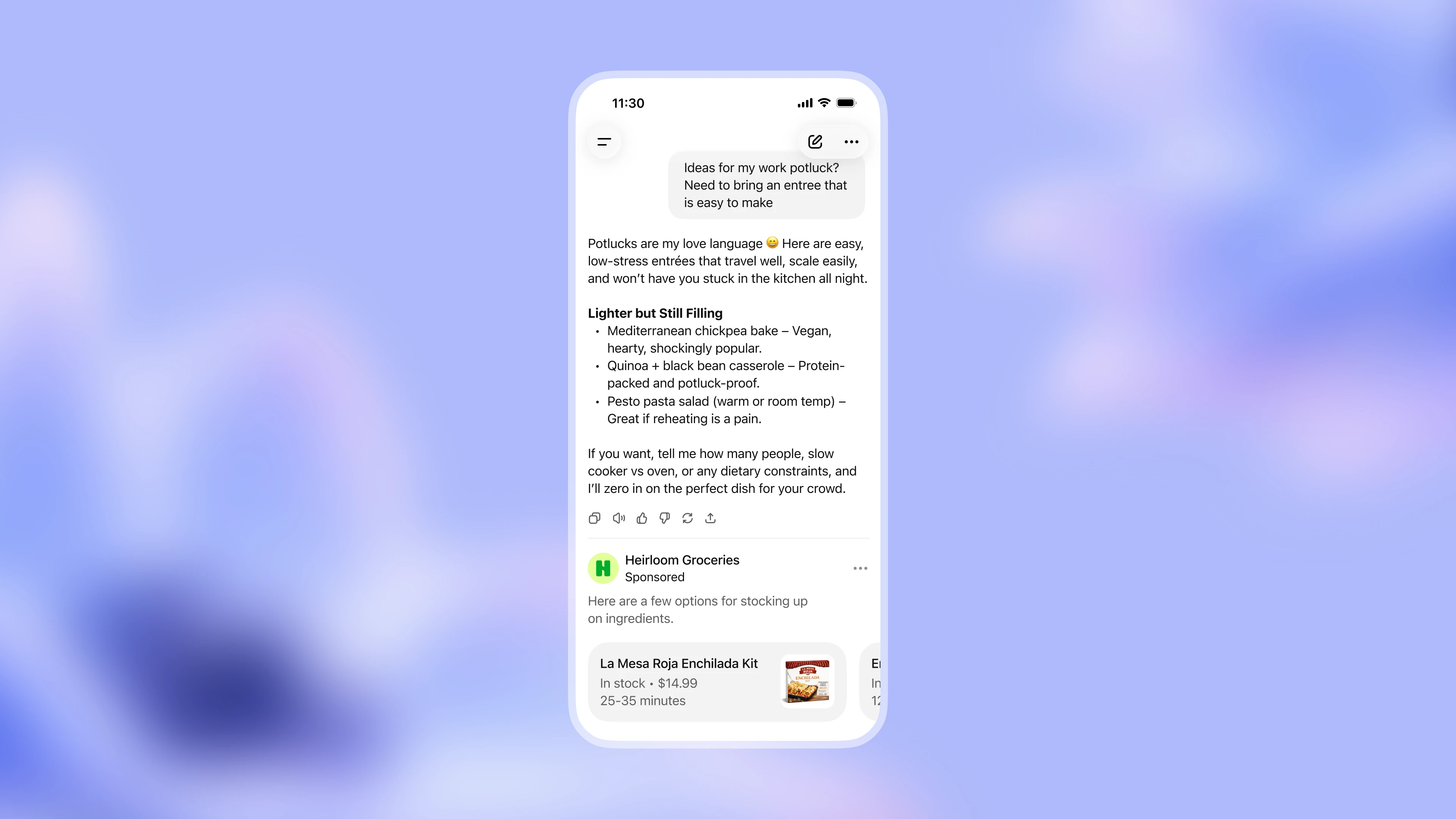
Advertising in ChatGPT is an opportunity to buy a sponsored placement. According to OpenAI’s published advertising principles, it does not buy influence over the answer beside it. The company says ads are labelled and separated from organic responses, and that conversations are not sold to advertisers.
That boundary changes the creative brief. A brand should be able to make a persuasive offer in its own name, with the facts available for someone to examine. It should not plan around borrowing the assistant’s voice or disguising a sales message as disinterested advice. The distinction is also useful when assessing an agency proposal. “Visibility in AI” can describe several different activities, with different costs and evidence. Ask which one is being offered.
What changed during 2026
The announcement, the start of testing and later expansion happened on different dates. Here are the relevant milestones in OpenAI’s published record.
| Date | Development |
|---|---|
| 16 January 2026 | OpenAI set out its advertising principles and plans to test sponsored placements at the bottom of answers. |
| 9 February 2026 | The company began a US test for logged-in adults using Free and Go. Its announcement described sponsored ads as visually distinct from the answer. |
| 5 May 2026 | OpenAI announced beta self-serve Ads Manager, partner buying, cost-per-click bidding and additional measurement tools. |
| 11 August 2026 | An update reported the launch of ChatGPT Ads in the UK, Mexico, Brazil, Japan and South Korea. |
Sources: January principles, testing and market updates, and May buying and measurement announcement. These establish the published product developments. They do not establish how well the channel will perform for a particular advertiser.
Keep the placement and the answer separate
An advertisement can be relevant to a conversation without being part of the answer. OpenAI’s testing description says its system matches advertising to conversational context and, depending on the experience and controls, past activity. It also says advertisers receive aggregate performance information, without access to individual chats, memories or personal details. Those are the provider’s stated boundaries, rather than an independent audit of every delivery decision.
For a buyer of agency services, the useful follow-up is concrete: show us the placement you will buy, the creative you will supply, the destination it will lead to and the report we will receive. A proposal that promises to make an assistant recommend the brand as a consequence of ad spend has confused the offer.
The same care applies to unpaid discovery. Improving product information, maintaining a useful website and making claims traceable are worthwhile publishing tasks. They do not create a guaranteed position in an answer. Record them as a separate workstream so an organic mention is not casually attributed to a paid campaign.
A useful creative brief starts with the unresolved decision
Imagine a person comparing a compact desk for a small flat. The brand could respond with another broad promise about better living. It could also explain the dimensions, the storage, delivery access and the point at which the desk stops being suitable. The latter gives the person something to decide with.
This is an illustrative brief, not evidence from a live campaign. It shows how to connect the offer to a real question without writing as if the advertiser can see a named person’s private conversation. Build the work around audience needs the brand can substantiate through its own research and product knowledge.
Ask the creative team to identify the claim that does most of the work. Then follow it through the journey. Does the landing page support it immediately? Are the relevant options easy to compare? If an image shows a particular finish or configuration, is that what the customer can actually obtain? The quality of the destination becomes part of the advertising brief.
A brand with a distinctive voice can keep it. Clarity does not require every advertiser to sound like a helpful software tooltip. The test is whether the expression makes the offer more understandable and recognisable. A joke that pushes the material information out of view is expensive decoration.
Measure the action you can observe
OpenAI’s May announcement added cost-per-click buying alongside impression-based buying, with conversion measurement through an API and a pixel. It also described aggregated reporting and a gradual opening of self-serve access. Confirm the current features available to the actual advertising account before the agency builds a plan around them.
Start with a defined business question. A retailer might want to know whether the campaign introduces additional profitable orders. A business selling a complex service might care about enquiries that meet a stated qualification standard. Neither question is answered completely by a rising click count.
Agree which system records the conversion, how a duplicate event will be handled and what attribution window is being used. Compare the result with a baseline that is relevant to the business. Where scale permits, an incremental test can help distinguish the effect of the advertising from purchases that would have happened anyway. Where it does not, say what the data can and cannot support.
Do not report an imagined sequence of private follow-up questions as a performance measure. If the report contains a metric described as “conversation influence”, ask for its definition, collection method and limits. A persuasive label is not a measurement method.
What an agency should be able to show you
The right team needs a grasp of the buying product and the offer being advertised. Those responsibilities might sit within one agency or across a media specialist, a creative team and the people maintaining the website. Name the owner of each part before work begins.
Ask for a plan that answers the following questions:
- What is currently available in our market and account, and which proposed features are still assumptions?
- Which audience problem and product claim will the creative address?
- What evidence and destination content must be ready before launch?
- How will spend, agency fees and production costs be separated?
- Which observable result will determine whether we continue, change or stop?
Prior experience should be described accurately. An agency may have substantial search or social advertising experience while still learning this channel. That can be a sensible basis for a bounded experiment. It is a poor basis for presenting untested mechanics as a settled competitive advantage.
The useful ambition is to make a recognisable, supported offer at an appropriate moment and learn whether it works. Give the agency a defined test, enough information to make good creative decisions and an honest way to report the result.